HeyGen vs Synthesia: Which AI Avatar Tool Is Actually Cheaper?
If you're making talking-head videos with an AI presenter — training content, product explainers, localized marketing videos — HeyGen and Synthesia are the two platforms every comparison eventually comes down to. Both use a credit system dressed up as a "minutes" allowance, and both make it genuinely hard to know what a video will cost you until after you've built it. A plan price or an impressive demo doesn't tell you what a real production workflow costs — so we pulled apart both pricing pages, and the underlying creator-vs-business positioning, to find the real number.
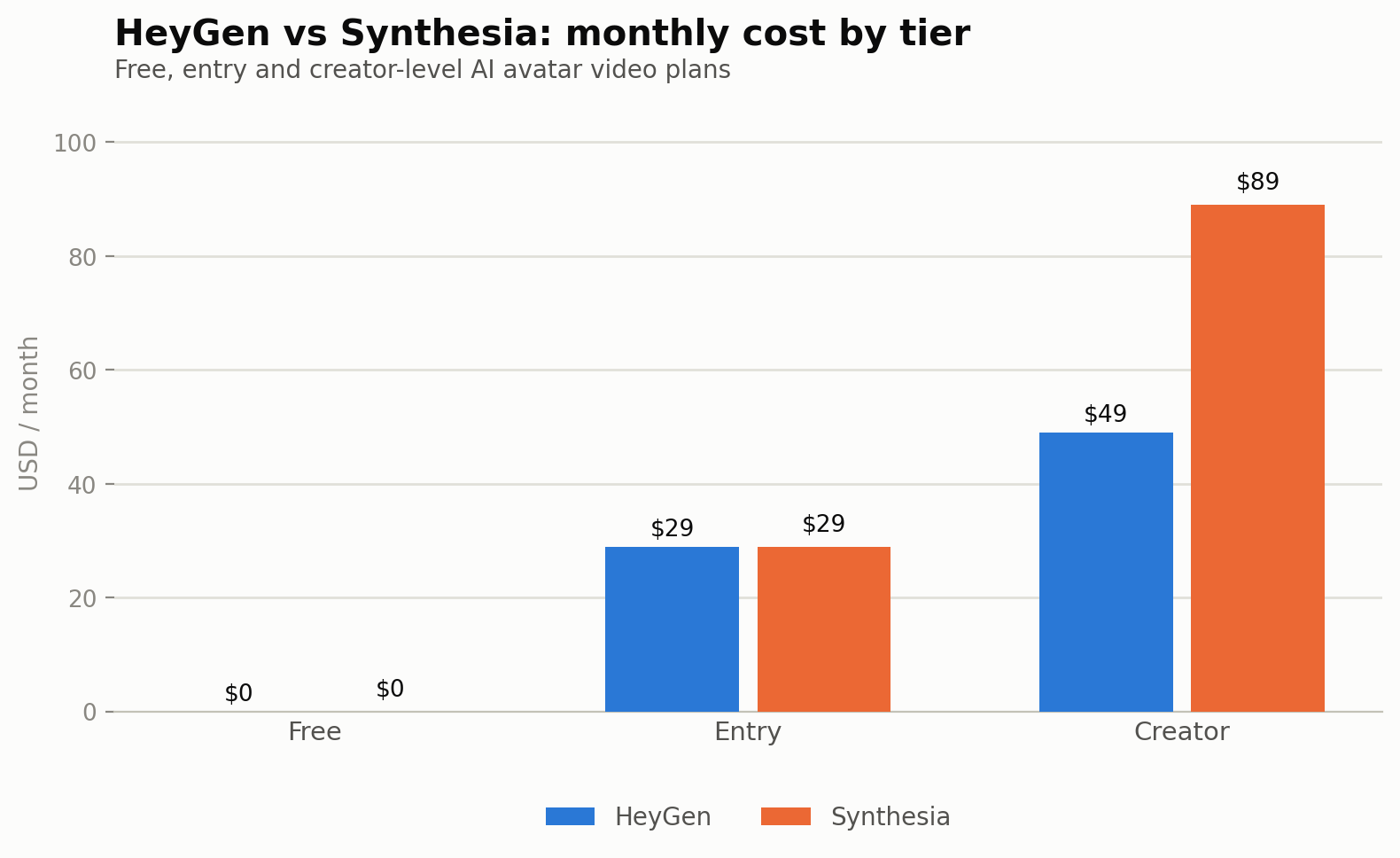
Quick verdict: at the $29/mo entry tier the two are close enough in price that avatar quality and workflow fit should decide, not cost — HeyGen gives more finished minutes per dollar and leans toward creator, marketing and localization work, while Synthesia is generally rated a notch above on realism and dubbing, and fits structured training and enterprise workflows better. For multilingual work specifically, Synthesia's Creator tier pulls ahead on AI dubbing minutes.
Open the calculator →Pricing side by side
| Plan tier | HeyGen | Synthesia |
|---|---|---|
| Free | $0 — 3 videos/mo, up to 1 min, 500+ stock avatars, 1 custom avatar | $0 — 10 min/mo, 1,200 credits |
| Entry | Creator — $29/mo ($24/mo annual), 600 credits, up to 30 min/video, 1080p | Starter — $29/mo ($18/mo annual), 12 min/mo, 1,200 credits, 48 min AI dubbing |
| Creator/Pro | Pro — from $49/mo, 1,000 credits, 4K export, 175+ languages | Creator — $89/mo, 30 min/mo, 3,600 credits, 140 min AI dubbing |
| Business | Business — $149/mo + $20/seat, 1,500 credits, up to 60 min/video | Enterprise — custom, unlimited minutes |
Creator platform vs business platform
This is the split that matters more than any single price point. HeyGen consistently positions itself toward creator, marketing, sales and localization use cases — social content, personalized sales videos, personal "digital twin" avatars, and multilingual marketing clips. Synthesia leans hard toward structured business video — employee training, onboarding, internal communications and enterprise-governed content, with workspace features, brand kits and SSO baked into its higher tiers.
Neither should be presented as universally better. A solo creator making direct-to-camera social content will likely find HeyGen's workflow more natural; an L&D team producing a 40-module onboarding course will likely find Synthesia's structured, governance-friendly workflow saves more time than the price difference costs.
Stock avatars and the "digital twin" option
Both platforms publish avatar counts, though the numbers describe different plan/access scopes and shouldn't be read as a direct apples-to-apples total: HeyGen's avatar library spans 1,100+ stock avatars and 300+ voices across its full catalog, with 500+ of those stock avatars already included on the free tier. Synthesia's feature pages cite 240+ ready-made avatars overall, with the exact count available varying by tier.
Both support building a custom "digital twin" — a personal or brand-specific avatar trained on your own likeness — under their current product structures. HeyGen includes 1 custom video avatar starting on its free tier and unlimited photo avatars from Creator up; Synthesia typically gates personal avatar creation to a higher tier. If a digital twin of yourself or a specific presenter is the actual point of the project, verify current consent and capture requirements on whichever platform you choose — policies here change as the underlying tech (and its risk profile) evolves.
HeyGen also shipped a new avatar model, Avatar V, in mid-2026, which its product pages currently position as the company's most realistic generation to date — worth checking a fresh demo of before assuming older comparison screenshots (including some circulating from earlier in the year) still reflect current quality.
The "minutes" number is a trap
Neither platform's headline minute allowance tells you what you'll actually get, because credits — not minutes — are the real currency on both tools. Longer scripts, 4K export, and translation into extra languages all draw from the same monthly pool at different rates. A 10-minute video in 1080p with no translation might cost a fraction of what a 3-minute video in 4K with three dubbed language tracks costs, even though the second video is shorter on screen.
Synthesia has the more dramatic quirk: Starter's price swings from $18/mo billed annually to $29/mo billed monthly — one of the biggest annual-vs-monthly gaps in this entire category. If you're testing the platform month to month before committing, budget for the $29 number, not the $18 one you'll see advertised first.
Cost per minute of finished video, realistically
Treating "minutes/month" as a literal cap understates both platforms, since the credit pool is usually the actual constraint long before the stated minute allowance runs out:
- HeyGen Free ($0): 3 videos capped at 1 minute each — enough to test avatar quality, not enough for real production.
- HeyGen Creator ($29/mo, $24 annual): 600 credits and videos up to 30 minutes is generous on paper, but 4K export and extra languages drain the pool fast — realistic output is closer to 10-15 finished minutes/month of polished, translated content.
- Synthesia Starter ($29/mo, $18 annual): 12 minutes/month plus 48 minutes of AI dubbing is a tighter allowance than HeyGen's Creator tier at the same list price, but Synthesia's avatar and lip-sync quality is frequently rated a notch above HeyGen's at this tier — you're paying for polish, not volume.
- Synthesia Creator ($89/mo): a big jump from Starter, but 140 minutes of AI dubbing makes this the better pick for multilingual campaigns specifically, where HeyGen's Pro tier costs less ($49) but includes fewer dubbing minutes relative to the price.
A practical way to actually test this
Rather than trusting either company's demo reel, generate the same short set of scripts on both platforms and compare the result against your real use case: a 60-second English script, a multilingual version of it, a product explainer, a training module, and a short marketing clip. Track production time, number of revisions needed, voice quality, avatar realism, and total credits burned — not just the sticker price. The cheapest avatar plan isn't cheap if every video needs extensive regeneration, pronunciation fixes, or manual correction; that hidden revision cost is easy to miss when comparing headline numbers.
Pros and cons
HeyGen
- More finished minutes per dollar at the $29 entry tier
- Custom digital-twin avatar creation included from the free tier up
- 175+ languages supported at the Pro tier, strong for localization-heavy work
- Avatar realism generally rated slightly below Synthesia at comparable price points
- Business tier adds a per-seat charge on top of the base subscription
Synthesia
- Widely considered the more polished, "corporate-safe" avatar and lip-sync quality
- Strong AI dubbing minute allowances, especially from the Creator tier up
- Workspace features, brand kits and SSO built for structured enterprise rollouts
- Fewer finished minutes per dollar than HeyGen at the same $29 price point
- Enterprise tier requires custom sales contact rather than transparent self-serve pricing
Hidden costs to watch for
Both platforms reset unused credits every billing cycle rather than letting them roll over, so overbuying a tier "to be safe" doesn't bank capacity for a slow month — you either use it or lose it. That makes it worth under-provisioning slightly and topping up with an add-on purchase if you go over, rather than pre-paying for a tier you might not fully use.
For agencies specifically, the real cost comparison isn't the base subscription — it's seat pricing, client workspace limits, brand controls, API rate limits, and how many revision rounds a typical client project needs. A cheaper base plan that requires more manual correction per client video can end up costing more in editor time than a pricier plan that gets it right on the first pass.
Where each one wins
Choose HeyGen if: you need the most finished-minutes-per-dollar at the entry tier, want a custom digital-twin avatar without paying extra for it, or your workflow leans toward creator, sales, and localization content rather than long-form training video.
Choose Synthesia if: avatar realism and lip-sync quality matter more than raw volume, you're building structured training or onboarding content where workspace and governance features matter, or you're producing multilingual training material where AI dubbing minutes matter more than video length.
Budget tip: if you only need occasional AI avatar clips, both free tiers are usable for testing, but neither survives real monthly production — plan to land on the $29 tier of whichever platform's avatar style and use case (creator vs. business) fits, since at that price point the two are close enough that fit should decide, not cost.
Common questions
Is HeyGen better than Synthesia?
It depends on the use case — HeyGen tends to fit creator, marketing and localization workflows better, while Synthesia tends to fit structured training and enterprise communication better. Neither is universally superior.
Do unused credits roll over month to month?
On both platforms, no — standard subscription credits reset each billing cycle and don't carry over, so overbuying a tier "just in case" doesn't bank unused capacity for later.
Can I create a digital twin of myself on either platform?
Both support custom/personal avatar workflows under their current product structures — HeyGen includes 1 custom avatar starting on the free tier, while Synthesia typically reserves personal avatar creation for a higher tier. Verify current consent and capture requirements before recording, since these policies evolve.
Which has more avatars to choose from?
HeyGen's full catalog spans 1,100+ stock avatars and 300+ voices; Synthesia's feature pages cite 240+ ready-made avatars. The two numbers describe different plan scopes, so treat them as a rough indication of breadth rather than a precise comparison.
Which is better for a one-off video rather than ongoing production?
Neither platform is built for single-use pricing — both require a monthly subscription to unlock meaningful output, so if you truly need one video, the free tier of either is more cost-effective than subscribing.
How does AI dubbing pricing interact with the base video cost?
Dubbing draws from a separate minute allowance on Synthesia (48 minutes on Starter, 140 on Creator) rather than the same credits used for the base video, so a heavily-dubbed multilingual project can exhaust the dubbing allowance well before the video-minute allowance runs out — budget the two separately rather than assuming one covers the other.
What should agencies compare beyond the base subscription price?
Seat pricing, client workspace limits, brand controls, API rate limits, and typical revision rounds per client video — a cheaper plan that needs more manual correction per video can cost more in editor time than a pricier plan that gets it right the first time.
Full tier breakdowns: HeyGen pricing guide and Synthesia pricing guide. Plug your expected monthly video minutes into our AI content cost calculator to see which tier actually covers your workload.
Sources and corrections
Full tier breakdowns: HeyGen pricing guide and Synthesia pricing guide. Plug your expected monthly video minutes into our AI content cost calculator to see which tier actually covers your workload.