Best AI Influencer Tools in 2026: Consistent Characters, Video and Voice
Creating one attractive AI-generated character is easy. Creating that same character a hundred times — same face, same body, consistent across different outfits, locations and lighting — is a genuinely hard problem, and it's the real challenge behind every serious AI influencer project. A successful virtual influencer needs consistent facial identity, consistent styling, realistic photos across many situations, natural-looking short-form video, a recognizable voice, talking video, and enough finished content to sustain a real posting schedule. No single tool does all of that equally well, which is why this is a stack decision, not a single-tool purchase.
Quick verdict: solve character consistency before anything else — a beginner stack of one image generator (Midjourney or FLUX) plus one video generator used for image-to-video (Kling or Runway), optional ElevenLabs for voice, and CapCut for editing is enough to validate whether your character concept works at all. Don't add avatar tools, voice cloning, or a full premium pipeline until you've proven you can reliably generate the same person across multiple situations.
Open the calculator →Quick picks by job
| Job | Good starting options | Typical entry cost |
|---|---|---|
| Character creation | Midjourney, FLUX | $10-12/mo |
| Consistent images across scenes | Runway References, Midjourney Edit workflows | $12-15/mo |
| Image-to-video animation | Kling, Runway | $10-15/mo |
| Premium cinematic clips | Google Veo 3.1 | $19.99/mo |
| Talking avatar | HeyGen | $29/mo |
| Voice & cloning | ElevenLabs | $6-22/mo |
| Scripts & personality | ChatGPT, Claude, Gemini | $0-20/mo |
| Editing | CapCut, Descript | $0-20/mo |
| Social graphics | Canva | $0-15/mo |
The hardest problem is consistency, not beauty
Generating one attractive image is trivial with any current image generator. Generating the same person, recognizably, across dozens of different locations, angles, outfits and lighting conditions is a completely different and much harder problem — and for an AI influencer, identity is the brand. A character that looks slightly different in every post reads as fake in a way that undermines the entire project, regardless of how good any individual image looks in isolation.
Build a character bible before you generate anything
Before generating production content, define the character on paper: name, age range, personality, specific facial features, eyes, hair, body type, wardrobe palette, makeup style, photography style, and content pillars (what the character actually posts about). Then build a reference pack — a front portrait, a 3/4 portrait, a side profile, a full body shot, a neutral expression, a smiling expression, and versions in both indoor and outdoor lighting. This reference pack becomes the foundation every future generation gets checked against, and it's far cheaper to get right once upfront than to fix identity drift across a hundred already-published posts later.
Tools for building and maintaining the character
Midjourney (currently on model version 8.2) is strong for the initial character exploration phase — fashion, lifestyle, environments and branding — with newer Edit-based workflows now handling what earlier "character reference" approaches used to do. FLUX is the better choice once you're past exploration and into scalable, repeatable production: an API-driven, pay-as-you-go pipeline that can realistically support a posting schedule of several images a week (5 posts/week across a year is 260 posts, before accounting for rejected generations, Stories, or ad variants) without per-image cost becoming unpredictable — see our Midjourney vs FLUX.2 comparison for the full pricing breakdown.
Runway's reference-based features are explicitly built around maintaining a consistent character or scene across different locations, lighting, and treatments — for an AI influencer project, the metric that actually matters is which tool preserves the same identifiable person across the most usable situations with the fewest retries, not which tool produces the single most striking individual image.
From still image to motion
Prefer animating an already-approved reference image over generating video directly from a text prompt and hoping the result matches your character — "approved image → animation" produces far more consistent results than "text prompt → hope it's the same person." Kling AI is strong specifically for this image-to-video step. Runway supports a broader version of the same workflow — reference, then image, then image-to-video, then editing — in one connected pipeline. Reserve Google Veo 3.1 for premium hero campaigns, luxury-style ads, or cinematic travel sequences where its higher cost is justified by a genuinely premium final product, not for routine daily content.
Voice and talking video
Use ElevenLabs for a consistent, designed voice — text-to-speech, authorized voice cloning if you're working with a real performer's voice under proper consent, multilingual generation, and dubbing if the character's audience is international. HeyGen is the natural fit for talking-avatar or direct-to-camera-style influencer videos where the character needs to appear to speak directly to the audience, distinct from generative video's strength in walking, traveling, dancing or interacting with an environment. Combine both where useful — a talking-avatar segment for a direct announcement, generative video for a lifestyle or travel scene.
Consent, rights, and not creating fake endorsements
If a real person's likeness or voice is involved anywhere in the pipeline, consent and usage rights matter, and this isn't optional or a minor compliance detail — it's a legal and reputational risk that scales with the account's reach. Don't fabricate endorsements or clone a real person's voice or likeness without appropriate rights and consent, regardless of how technically easy current tools make it.
The two hidden costs specific to AI influencers
Identity drift. If 100 generated images only produce 40 that pass your own identity-approval bar, your real usable-output rate is 40% — the metric that matters is total generation cost divided by identity-approved outputs, not cost per raw generation. A cheaper generator with worse identity consistency can easily cost more per usable post than a pricier one that gets the character right more often.
Video retries from motion artifacts. Motion introduces failure modes that still images don't have — facial drift across frames, hair changing mid-clip, distorted hands, clothing that shifts inconsistently. Final video seconds are not the same as generated video seconds once you account for how many attempts a clean, identity-consistent clip actually takes.
Why the cheapest model can be the wrong choice
This is worth internalizing with real numbers: if Model A costs $0.10/image with a 30% acceptance rate, getting 80 accepted images requires roughly 267 generations — about $26.70. If Model B costs $0.20/image but has an 80% acceptance rate, the same 80 accepted images need only 100 generations — $20. The nominally "more expensive" model is actually cheaper in practice, because acceptance rate compounds with generation cost to determine real spend. Cheap generation does not guarantee cheap production.
Two starter stacks
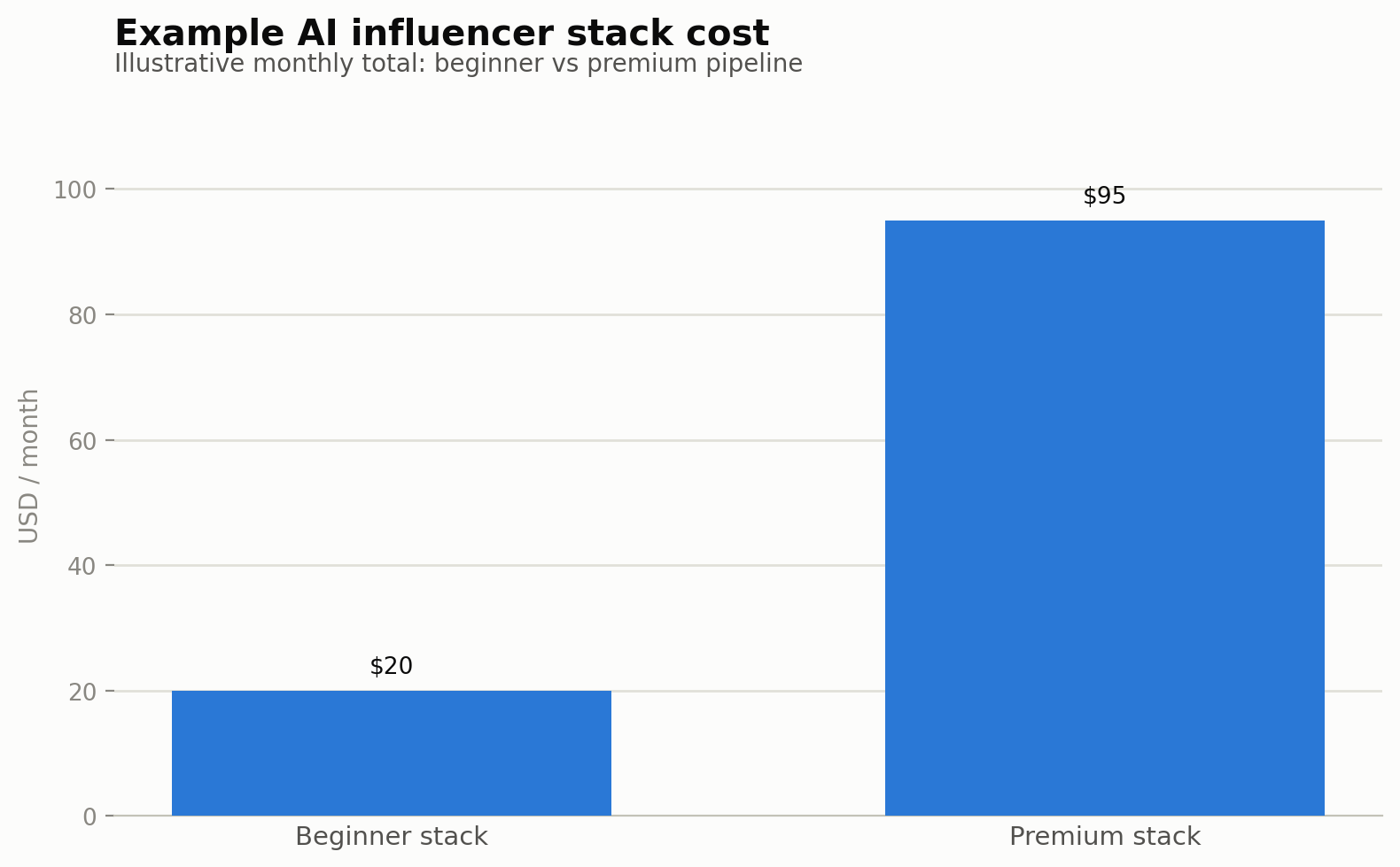
Beginner stack: Midjourney or FLUX for character creation, Kling or Runway for image-to-video, optionally ElevenLabs for voice, and CapCut for editing — enough to prove the character concept works before investing further.
Premium stack: FLUX or Midjourney → Runway References for consistency → Kling, Runway or Veo for video → ElevenLabs for voice → HeyGen for talking segments → CapCut for editing → publishing. Only justify this full pipeline once the beginner stack has validated that the character resonates with an actual audience.
Do you need every overlapping tool?
Midjourney and FLUX together only make sense if they're genuinely serving different jobs — exploration versus scaled production, for instance — not because both are popular. Kling and Runway together only make sense if both are regularly used for different situations. HeyGen and ElevenLabs solve different jobs (avatar presence versus voice) and can coexist, but add each only when the specific need arises, not preemptively.
Build reusable assets, not one-off generations
The highest-leverage investment in an AI influencer project isn't any single generation — it's the reusable assets around it: the reference pack, a wardrobe library, a consistent voice identity, prompt templates that reliably reproduce the character, a set of established locations, a caption style guide, and any approved product assets for brand deals. These compound in value with every piece of content produced, while individual generations don't.
Common questions
What's the single hardest part of building an AI influencer?
Consistency — generating the same recognizable character across many different situations, angles and lighting conditions is far harder than creating one attractive standalone image, and it's the problem worth solving first before investing in the rest of the stack.
Do I need a talking avatar tool like HeyGen, or is generative video enough?
It depends on the content format — HeyGen suits direct-to-camera, scripted-presentation-style content, while generative video (Kling, Runway) suits walking, traveling, dancing and environmental interaction. Many successful projects use both for different content types.
How much does running an AI influencer actually cost per month?
It depends on posts per month, images per post, video frequency, your image and video acceptance rates, voice and avatar minutes needed, and how many overlapping subscriptions you're running — budget around your actual content calendar rather than a generic "AI influencer cost" figure.
Is it legal to clone a real person's voice or likeness for an AI influencer?
Only with appropriate consent and usage rights from that person — cloning or fabricating endorsements without consent is both a legal and reputational risk, regardless of how easy current tools make it technically.
Why would a more expensive AI model actually be the cheaper choice?
Because acceptance rate matters as much as per-generation price — a pricier model with a much higher rate of identity-consistent, usable output can cost less per accepted image than a cheaper model that needs many more attempts to get the same number of usable results.
Should I start with Midjourney or FLUX for character creation?
Midjourney tends to suit the initial exploration phase — fashion, lifestyle, environment testing — while FLUX suits scaled, repeatable, API-driven production once you're past exploration and into a regular posting schedule. See our detailed comparison for the cost breakdown at different volumes.
What should I build before scaling up an AI influencer project?
Prove you can reliably generate the same character first, then add motion, then voice, then scale — in that order. Building the full premium pipeline before validating that the character concept and content resonate with an audience is the most common way this kind of project overspends.
Tool-specific breakdowns: Midjourney vs FLUX.2, best AI video generators, HeyGen vs Synthesia, ElevenLabs vs alternatives. Model your own expected content calendar in our AI content cost calculator.
Sources and corrections
Tool-specific breakdowns: Midjourney vs FLUX.2, best AI video generators, HeyGen vs Synthesia, ElevenLabs vs alternatives. Model your own expected content calendar in our AI content cost calculator.