Midjourney vs FLUX.2: Which Is Actually Cheaper Per Image?
Midjourney and FLUX.2 solve the same basic problem — text-to-image generation — through pricing models that couldn't be more different. Midjourney is a flat monthly subscription with a distinctive visual style, built for creative exploration inside a Discord or web interface. FLUX.2, from Black Forest Labs, is sold almost entirely as pay-as-you-go API access, priced per image at a fraction of a cent, aimed at developers and teams building generation into their own products rather than browsing a creative tool directly. A useful shorthand: Midjourney for ideation, FLUX for production — though that's a starting point, not a universal rule.
Quick verdict: for scalable, high-volume, API-driven or pay-as-you-go image generation, FLUX.2 is dramatically cheaper per image than any Midjourney tier — often by one or two orders of magnitude. For visual exploration, style, and creative ideation inside a ready-made interface, Midjourney's flat subscription remains the more accessible starting point, since FLUX has no consumer app of its own.
Open the calculator →Pricing side by side
| Access model | Midjourney | FLUX.2 |
|---|---|---|
| Entry | Basic — $10/mo ($8/mo annual) | Pay-as-you-go API — no subscription |
| Mid | Standard — $30/mo ($24/mo annual) | Dev: $0.0084/image · Pro: $0.015/image |
| Power user | Pro — $60/mo ($48/mo annual) | Klein 4B: $0.012/image · Klein 9B: $0.015/image |
| Top tier | Mega — $120/mo ($96/mo annual) | Flex: $0.030/image · Max: $0.073/image |
| Self-hosted licensing | Not applicable | Builder: 10K images/mo · Platform/Professional: 100K images/mo · Enterprise: custom |
Two fundamentally different products, not just two prices
This comparison only makes sense once you accept that Midjourney and FLUX.2 aren't really competing for the same buyer. Midjourney sells you access and a workflow — a specific aesthetic, a Discord/web interface, parameter controls (stylize, chaos, weird), and a community around it. FLUX.2 sells you raw generation capacity through an API, with no built-in creative interface of its own — you either build one, or access FLUX models through a third-party app (several image tools now offer FLUX as one of several selectable models).
That distinction matters more than the price gap itself. A solo creator who wants to sit down and generate images interactively has no easy way to "just use" FLUX.2 the way they'd open Midjourney in Discord — they'd need to build or find a front-end first. A developer building an app that generates thousands of product images has no reason to pay Midjourney's flat subscription when FLUX's per-image API pricing scales down to fractions of a cent at volume.
Cost per 100 images, the honest comparison
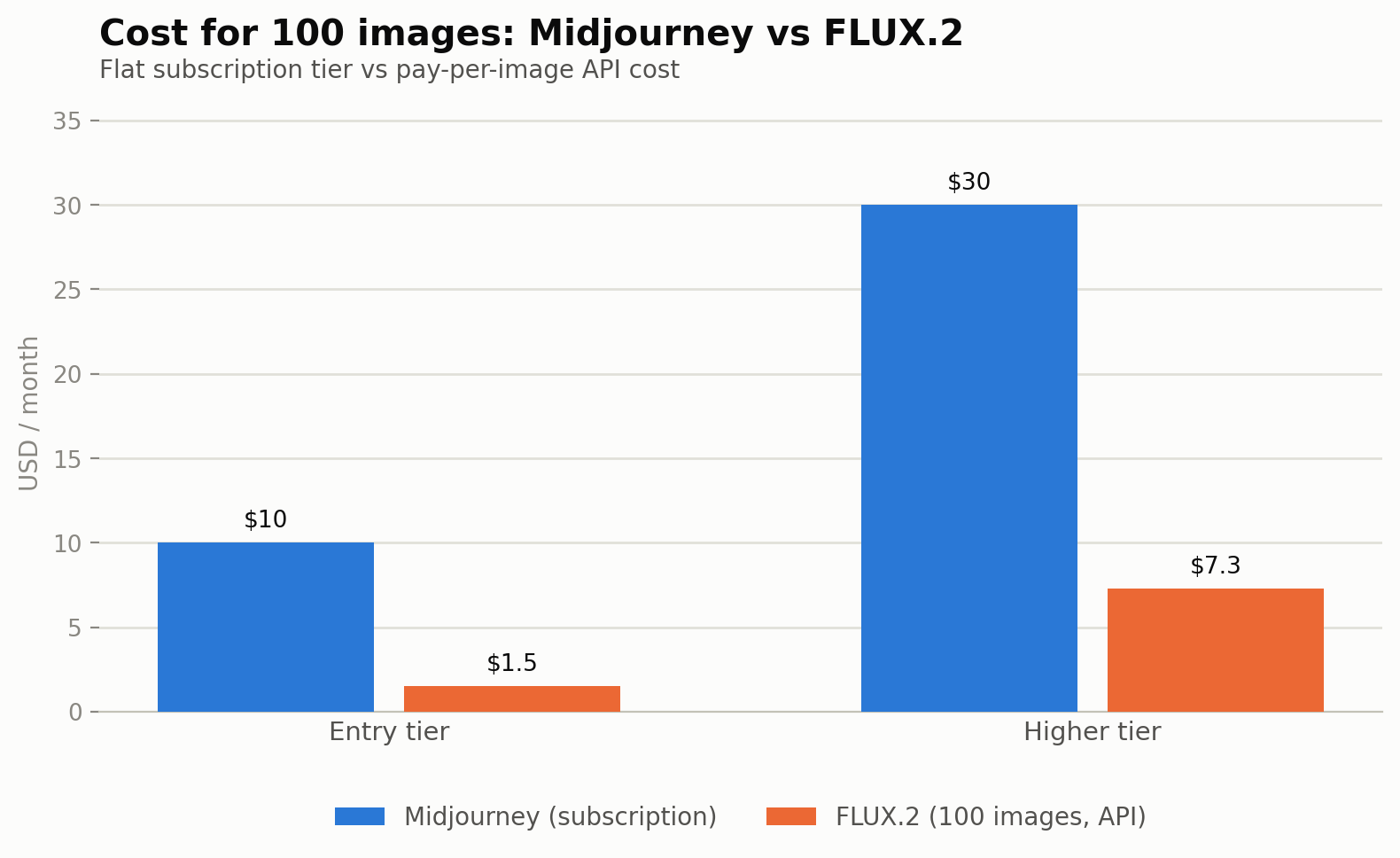
Because the two pricing models are structurally different, here's what 100 generated images actually costs on each, accounting for the fact that Midjourney's Basic tier has no Relax-mode fallback (see our Midjourney vs Adobe Firefly guide for the full breakdown of Midjourney's Fast-hours-and-Relax system):
- Midjourney Basic ($10/mo): tight for 100 images without a Relax fallback — most casual users need to move to Standard for comfortable volume.
- Midjourney Standard ($30/mo): comfortable for 100+ images a month thanks to unlimited Relax-mode generation once fast hours run out.
- FLUX.2 Pro API (~$0.015/image): 100 images costs about $1.50 — a small fraction of even Midjourney's cheapest tier, but this price buys raw generation only, with no interface, community, or Discord-style workflow included.
- FLUX.2 Max API (~$0.073/image): even at FLUX's highest per-image tier, 100 images costs about $7.30 — still well under Midjourney's Basic subscription price.
The gap is real and large, but it's not really an apples-to-apples "which is cheaper" question — it's "which of these two very different products do you actually need." If you're generating images through code, at scale, without needing a creative-exploration interface, FLUX.2's per-image cost is close to unbeatable. If you want to sit down and iteratively explore prompts in a ready-made app with a recognizable style, that experience doesn't exist on FLUX at any price — you're paying Midjourney (or a third-party app that wraps FLUX) for the workflow, not just the pixels.
Model variety inside FLUX.2 itself
FLUX.2 isn't one model — Black Forest Labs offers several variants at different price and quality points within the same API: Dev ($0.0084/image) is the lower-cost, open-weights-adjacent option; Pro ($0.015/image) is the standard production-quality tier; the two Klein variants (4B and 9B, $0.012-$0.015/image) sit in a similar range with different underlying model sizes; Flex ($0.030/image) and Max ($0.073/image) scale up for higher fidelity or more control. Even at the top of that range, Max is still cheaper per image than a single day of Midjourney Basic's monthly subscription divided across a month's generation.
For teams self-hosting FLUX's open-weight models rather than using the hosted API, Black Forest Labs also offers licensing tiers — Builder (10,000 images/month), Platform and Professional (100,000 images/month each), and custom Enterprise — but these are infrastructure-and-licensing arrangements for running your own inference, not a consumer pricing option comparable to Midjourney's subscription.
Pros and cons
Midjourney
- Distinct, widely recognized visual style many brands specifically request
- Ready-made Discord/web interface with parameter controls, no setup required
- Unlimited Relax-mode generation on Standard and above
- No per-image cost transparency — you're paying for a subscription tier, not metered usage
- Dramatically more expensive per image than FLUX.2 at any real volume
FLUX.2
- Per-image cost is a fraction of a cent at most tiers — unbeatable at scale
- Multiple model variants (Dev, Pro, Klein, Flex, Max) let you match cost to quality needs precisely
- No built-in creative interface — requires building or finding a front-end to use interactively
- No single "house style" — output quality and character depend entirely on prompting and model choice
- Self-hosted licensing tiers add complexity if you outgrow the simple pay-as-you-go API
Hidden costs to watch for
FLUX.2's per-image price varies by hosting provider — the cheapest published rate for a given model (Replicate, Fal, Together, DeepInfra and others all host FLUX models at slightly different prices) isn't necessarily what you'll pay through Black Forest Labs' own API directly. Before committing to a volume estimate, check pricing on the specific provider you plan to integrate with, since the spread between providers can be meaningful at high volume.
Midjourney's annual discount is worth factoring in if you're committing long-term: roughly 20% off across every tier, which matters more here than usual because there's no equivalent "pay only for what you use" option on Midjourney the way there is on FLUX — you're paying for access whether you generate 10 images or 1,000 that month.
Where each one wins
Choose Midjourney if: you want a ready-made creative-exploration workflow with a distinctive, recognizable style, and you don't need to integrate image generation into your own product or pipeline via code.
Choose FLUX.2 if: you're building an application, product feature, or automated pipeline that needs image generation at scale, and per-image cost predictability matters more than a polished consumer interface.
Use both if: you're running a content operation that needs both creative exploration (Midjourney, for hero images and ideation) and production-scale generation (FLUX.2, for bulk or programmatic image needs) — the two rarely compete for the same specific task once you look past the headline price comparison.
Common questions
Can I use FLUX.2 without writing any code?
Not directly through Black Forest Labs' own API — you'd need a third-party app or interface that integrates FLUX as one of its models. Several existing AI image tools now offer FLUX alongside other models, which is the more practical route for non-developers.
Is FLUX.2 really cheaper than Midjourney, or is that comparing different things?
Both are true — FLUX.2's per-image cost is genuinely far lower at any real volume, but the comparison isn't apples-to-apples: Midjourney's price includes a full creative interface and workflow, while FLUX.2's price is for raw generation capacity only.
Which FLUX.2 model should I use if I just want the best quality regardless of cost?
Max, at roughly $0.073/image, is FLUX.2's highest-fidelity option — still a fraction of Midjourney's per-image-equivalent cost, but noticeably more than the Dev or Klein variants for higher control and quality.
Does Midjourney offer any pay-as-you-go option instead of a subscription?
No — Midjourney is subscription-only across all four tiers (Basic through Mega), with no metered or pay-per-image alternative currently offered.
Can FLUX.2's open-weight models be self-hosted instead of using the API?
Yes — Black Forest Labs offers licensing tiers (Builder, Platform, Professional, Enterprise) for organizations that want to run FLUX models on their own infrastructure rather than paying per API call, though this adds real infrastructure and engineering overhead compared to the simple pay-as-you-go API.
Is there a meaningful quality difference between Midjourney and FLUX.2 output?
Yes, and it's largely a matter of style rather than a strict better-or-worse — Midjourney has a distinctive, often more painterly aesthetic, while FLUX.2 is generally noted for strong photorealism and text rendering within images, an area many generators (including earlier Midjourney versions) have historically struggled with.
Do FLUX.2 API prices ever change, or are they fixed?
They vary by hosting provider and can change as providers compete on price — the figures here reflect published rates as of this article's publication, so confirm current pricing with your chosen provider before budgeting a large-scale integration.
Midjourney pricing from our Midjourney pricing guide and Midjourney vs Adobe Firefly comparison. FLUX.2 pricing sourced from Black Forest Labs' official pricing page and current third-party API cost trackers as of publication — confirm current per-provider rates before committing to a large-scale integration. Model your own expected generation volume in our AI content cost calculator.
Sources and corrections
Midjourney pricing from our Midjourney pricing guide and Midjourney vs Adobe Firefly comparison. FLUX.2 pricing sourced from Black Forest Labs' official pricing page and current third-party API cost trackers as of publication — confirm current per-provider rates before committing to a large-scale integration. Model your own expected generation volume in our AI content cost calculator.