Baidu ERNIE Pricing 2026: What Does China's Other AI Giant Actually Charge?
Direct answer
China's foundation model race is heating up, so where does Baidu's ERNIE ecosystem land on cost and performance? On Baidu's official Qianfan AI platform, flagship pricing has taken a pleasant turn: ERNIE 5.1 now costs less to run than ERNIE 5.0, the model it replaced. That's not how model upgrades usually go.
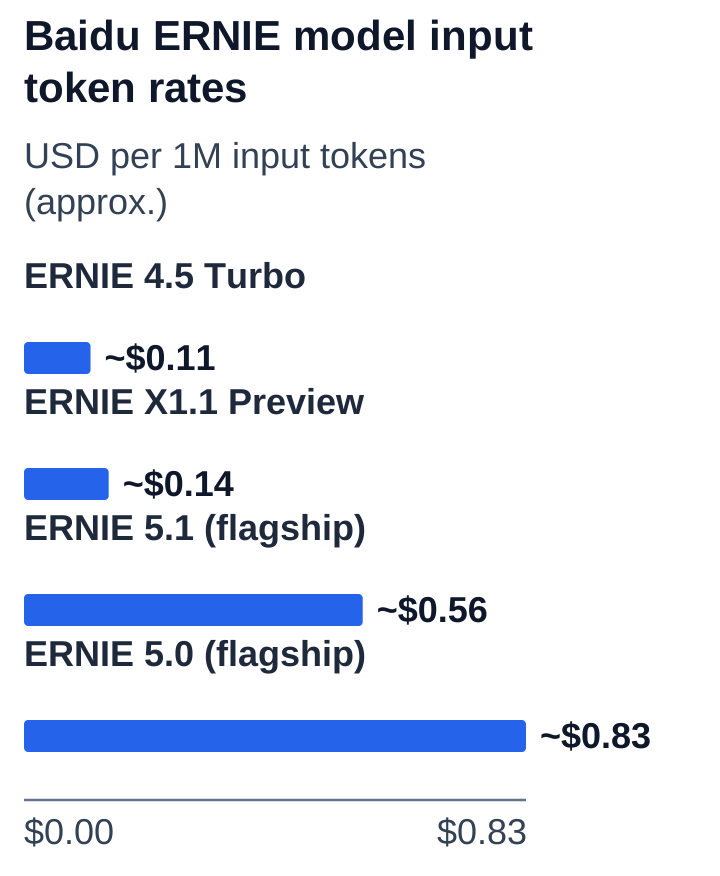
On the official Qianfan billing catalog, ERNIE 5.1 lists at ¥4.00 per million input tokens and ¥18.00 per million output tokens for standard requests with up to 32K input tokens. For long-context requests between 32K and 128K, it scales to ¥6.00/¥22.00. Older ERNIE 5.0 models bill at ¥6.00/¥24.00 at the same entry tier. In dollar terms (at an assumed baseline conversion of ¥7.2 per US$1), ERNIE 5.1 works out to roughly $0.56 per million input tokens and $2.50 per million output tokens.
For international teams, the big practical question is geography. Mainland Qianfan accounts can deploy ERNIE 5.1 directly, but Baidu's international cloud consoles frequently lag behind and tend to list ERNIE 5.0 or specialized enterprise endpoints. If you're deploying outside mainland China, take a minute to check your account's regional model menu before you finalize any architecture plans. It's a much cheaper check than a redesign.
Consumer product
Baidu's consumer assistant, ERNIE Bot, is still free for individual text conversations and basic search synthesis on web and mobile. Advanced multimodal capabilities and high-concurrency developer access go through Baidu Cloud Qianfan.
API / Qianfan pricing, from Baidu's official billing page (cloud.baidu.com/doc/qianfan/s/wmh4sv6ya), updated by Baidu September 16, 2026. Original prices are published per thousand tokens in RMB; normalized here to per-million for comparability (×1,000), with an approximate USD conversion at an assumed ¥7.2 = $1 exchange rate — a stated assumption, not an official Baidu USD rate:
| Model | Input (¥/M → $) | Output (¥/M → $) | Tier |
|---|---|---|---|
| ERNIE 5.1 (current flagship) | ¥4.00 → $0.56 | ¥18.00 → $2.50 | ≤32K input |
| ERNIE 5.1 | ¥6.00 → $0.83 | ¥22.00 → $3.06 | 32K–128K input |
| ERNIE 5.0 (previous flagship) | ¥6.00 → $0.83 | ¥24.00 → $3.33 | ≤32K input |
| ERNIE 5.0 | ¥10.00 → $1.39 | ¥40.00 → $5.56 | 32K–128K input |
| ERNIE 4.5 Turbo (all current dated variants) | ¥0.80 → $0.11 | ¥3.20 → $0.44 | cache-hit input: ¥0.20 → $0.03 |
| ERNIE X1.1 Preview (reasoning) | ¥1.00 → $0.14 | ¥4.00 → $0.56 | Marked "即将下线" (retiring soon) directly on Baidu's own page |
Web search and grounding fees: Triggering live Baidu search grounding costs ¥0.004 per query (approximately $0.00056). The retrieved search snippets are then billed as standard input tokens on the LLM generation that follows. If you're running a high-throughput app, prepaid grounding bundles are available: 10,000 search queries for ¥38, and 50,000 queries for ¥190.
Third-party model resale markup: Qianfan also resells non-Baidu foundation models, and the platform adds a markup. For example, Zhipu's GLM-5.3 is listed on Qianfan at ¥8.00/¥28.00 per million tokens, which is considerably higher than calling Z.ai directly. The practical takeaway: if your architecture does multi-model routing, calling each provider through its native API endpoint almost always gives you lower unit costs.
Real workload calculations
To make monthly API spend feel concrete, here are three typical production tiers on ERNIE 5.1 (≤32K input tier: ¥4.00/¥18.00 per million tokens):
| Workload | Formula (RMB) | Cost (¥) | Cost (≈$) |
|---|---|---|---|
| A — Everyday (1M in, 250K out) | (1×¥4.00) + (0.25×¥18.00) | ¥8.50 | ≈$1.18 |
| B — Coding/reasoning (10M in, 3M out) | (10×¥4.00) + (3×¥18.00) | ¥94.00 | ≈$13.06 |
| C — High volume (400M in, 100M out/mo) | (400×¥4.00) + (100×¥18.00) | ¥3,400.00 | ≈$472.22 |
One detail worth keeping in mind: the ≤32K tier applies per individual request, not to your cumulative monthly volume. A high-throughput microservice handling millions of short customer queries stays on the lower rate bracket no matter how large the monthly token total gets.
Migration notice on reasoning models: ERNIE X1.1 Preview is officially marked for retirement on Baidu's catalog. If you have reasoning workloads on it, now is a good time to move them to the native "deep thinking" mode built into ERNIE 5.0 and ERNIE 5.1. Future-you will appreciate not doing this in a panic.
Comparison with Qwen, DeepSeek, and Doubao
So how does ERNIE stack up against the other big Chinese AI platforms?
Within Qianfan itself, Baidu also resells DeepSeek-V4.1-Flash at ¥2.00/¥8.00 per million tokens during peak hours (8:00–22:00) and ¥1.00/¥4.00 per million off-peak (22:00–8:00). Even at peak pricing, DeepSeek Flash on Qianfan is half the price of ERNIE 5.1 (¥4/¥18). ByteDance's Doubao on Volcano Engine is cheaper still for high-volume conversational bots ($0.02 to $0.05 per 1M input tokens).
Where ERNIE really earns its place is in Chinese-language enterprise search, Baidu ecosystem data grounding, and the domestic compliance certifications that state-owned and financial institutions in mainland China require. If those matter to you, the price gap becomes a lot less important.
Practical economics: building enterprise document automation
Picture an enterprise document extraction SaaS that analyzes Chinese business contracts and processes 400M input tokens and generates 100M summary tokens per month (Workload C: ¥3,400 per month, or roughly $472 USD). Say it charges 30 corporate clients ¥1,000 per month each, for ¥30,000 in total revenue. The underlying ERNIE 5.1 API cost then comes to just 11.3% of revenue. That leaves an 88.7% gross software margin to cover infrastructure, sales, and operations, which is a comfortable cushion.
FAQ
Is ERNIE 5.1 available outside mainland China? Mainland Qianfan accounts have full direct access to ERNIE 5.1. International consoles have historically lagged and shown ERNIE 5.0. If you're operating outside mainland China, confirm model availability in your regional console before designing your production pipeline.
Which model is cheaper: ERNIE 5.0 or 5.1? ERNIE 5.1 is cheaper. It costs ¥4.00/¥18.00 per million tokens, compared to ¥6.00/¥24.00 on ERNIE 5.0 for the standard input tier. Baidu's newer flagship is both more capable and 33% less expensive on input tokens.
What is happening to ERNIE X1.1 Preview? Baidu has scheduled ERNIE X1.1 Preview for retirement. If you're using this endpoint, plan to migrate to the native reasoning mode supported inside ERNIE 5.0 and 5.1.
How does ERNIE 5.1 compare on price against DeepSeek and Qwen? At roughly $0.56/M input and $2.50/M output, ERNIE 5.1 is competitively priced against Western models like GPT-4o-mini and Claude Sonnet. It does sit above the hyper-budget Chinese alternatives like DeepSeek Flash ($0.15–$0.30/M) and Qwen-Flash.