Runway vs Google Veo 3.1: Which One Actually Fits Your Budget?
Runway and Google's Veo 3.1 both show up on every serious "best AI video generator" shortlist in 2026, but they're structured almost as differently as two video tools can be. Runway is a broad, multi-model production platform built for creators and teams who need generation, editing-oriented features and API access in one place. Veo 3.1 is Google's premium video model, sold either bundled inside a Google AI subscription or metered per second through Vertex AI's developer API. Comparing "Runway's price" against "Veo's price" only makes sense once you're clear on which of Veo's two very different purchase paths you're actually pricing against.
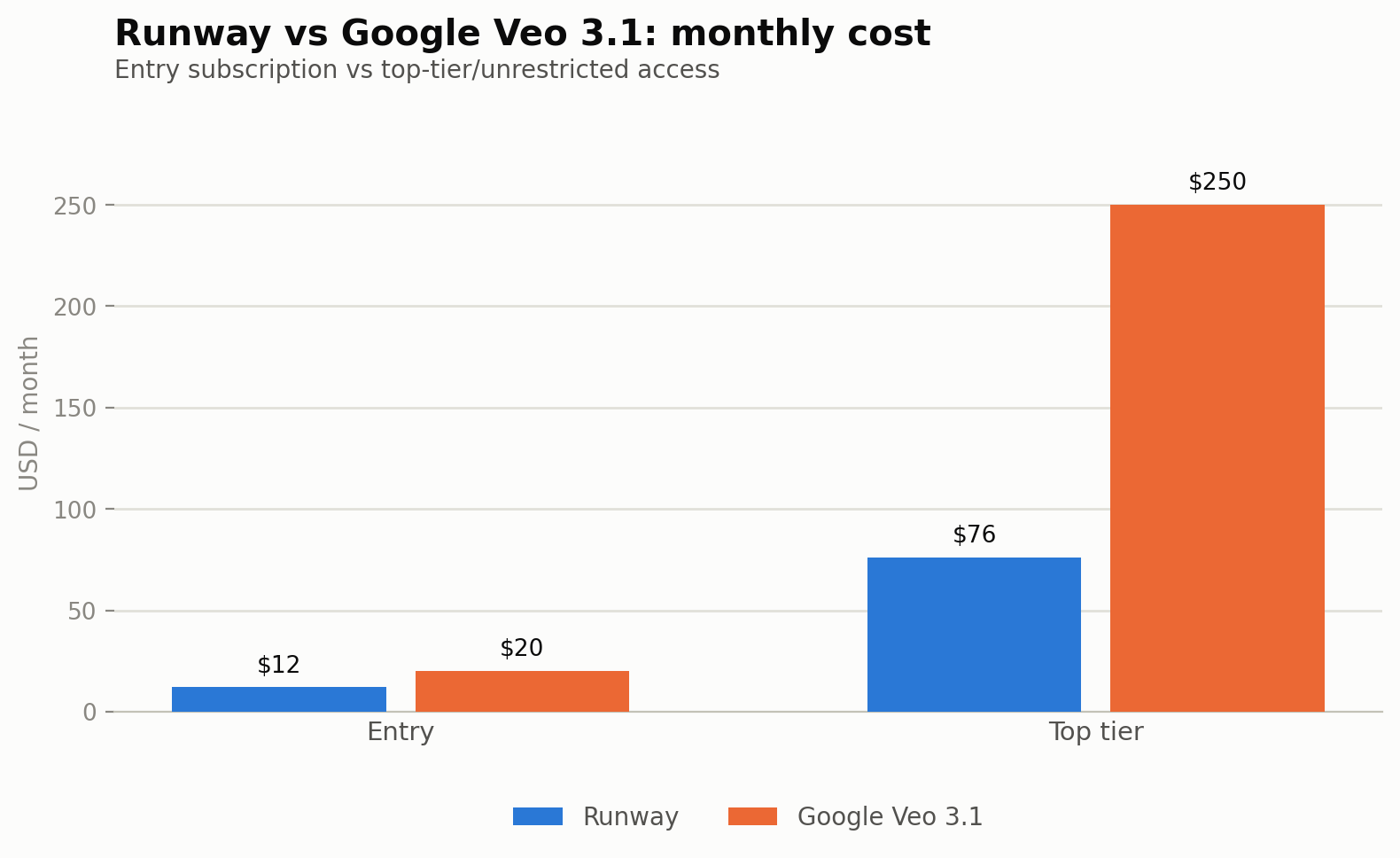
Quick verdict: for a self-serve monthly subscription, Runway's $12/mo annual Standard plan is dramatically cheaper than either of Google's AI subscription tiers that include Veo access. Veo 3.1 becomes cost-competitive only through its per-second Vertex AI API pricing, which suits developers building a custom pipeline more than it suits someone who just wants a monthly video-generation plan.
Open the calculator →Pricing side by side
| Access tier | Runway | Google Veo 3.1 |
|---|---|---|
| Free | 125 one-time credits | Not available on any free tier |
| Entry subscription | Standard — $12/mo annual ($15 monthly), 625 credits | Google AI Pro — $19.99/mo, limited Veo 3.1 Fast, daily cap |
| Mid | Pro — $28/mo annual ($35 monthly), 2,250 credits | — |
| Top self-serve | Max — $76/mo annual ($95 monthly), 9,500 credits | Google AI Ultra — $249.99/mo, full Veo 3.1, 4K, no watermark |
| API (pay-as-you-go) | Gen-4 Turbo ~5 credits/sec, Gen-4.5 ~12 credits/sec, dev credits ~$0.01 each | Vertex AI: $0.05-$0.60/second by model tier and resolution |
A production platform vs a bundled premium model
Runway's entire pricing structure is built around giving you a broad toolkit for one subscription price — multiple generation models, parallel generations, unlimited 4K upscaling even at the entry tier, and developer API access for teams that want to build on top of it. Every dollar you pay Runway buys generation capacity plus workflow features.
Google's approach is different: Veo 3.1 isn't sold as its own product to consumers, it's a feature inside Google AI Pro ($19.99/mo) and Google AI Ultra ($249.99/mo) — subscriptions that also include Gemini access, expanded storage and other Google One features. If you'd subscribe to Google AI Pro anyway, Veo access is close to a free bonus. If video generation is the only reason you'd pay Google anything, you're paying for the entire bundle just to reach the video feature — a structurally more expensive path than Runway's dedicated, video-first pricing.
The API alternative changes the calculus
For developers rather than casual users, both platforms offer a second, per-second pricing path. Runway's Gen-4 Turbo runs about 5 credits/second (developer credits priced around $0.01 each, so roughly $0.05/second), while its newer Gen-4.5 model runs about 12 credits/second (~$0.12/second). Google's Vertex AI pricing for Veo 3.1 ranges from $0.05/second (Lite 720p) up to $0.60/second (Standard 4K).
At the lower end, the two APIs land in a similar range — Runway's Gen-4 Turbo and Veo's Lite/Fast 720p tiers are all roughly $0.05-$0.12/second. The gap widens sharply at the top: Veo's Standard 4K at $0.60/second is meaningfully more expensive per second than anything in Runway's published API pricing, reflecting Veo's positioning as the premium, native-audio-capable option at its highest quality setting.
Cost per finished clip, realistically
For someone producing roughly 15-20 short clips a month through the consumer subscriptions (not the API):
- Runway Standard ($12/mo annual, 625 credits): comfortably covers a modest monthly output using Gen-4 Turbo-tier generation, with room for parallel generations and unlimited 4K upscaling.
- Runway Pro ($28/mo annual, 2,250 credits): a meaningful step up in volume, and where Gen-4.5's higher quality becomes practical without exhausting the credit pool immediately.
- Google AI Pro ($19.99/mo): Veo 3.1 Fast access is capped daily rather than by a monthly credit pool, making realistic monthly output harder to predict than Runway's straightforward credit system.
- Google AI Ultra ($249.99/mo): removes the daily cap and unlocks 4K, but at roughly 8-20x Runway's comparable tiers, this only makes sense if the broader Ultra bundle is also part of the value you're seeking.
For a pure self-serve monthly video subscription, Runway is the clearly cheaper and more flexible option — Google Veo 3.1 earns its price primarily through native-audio quality at the API level or as a bonus feature inside a Google AI subscription you'd already want.
Pros and cons
Runway
- Multiple generation models plus editing-oriented features in one subscription
- Parallel generations and unlimited 4K upscaling from the entry tier up
- Developer API pricing is transparent and competitive at the lower tiers
- No free recurring allowance — the free tier is a one-time 125-credit grant
- Higher-quality Gen-4.5 model burns credits more than twice as fast as Gen-4 Turbo
Google Veo 3.1
- Native audio generation and cinematic quality frequently rated among the best available
- Vertex AI API gives precise, pay-as-you-go per-second control for custom pipelines
- Bundled value is strong if you already want Google AI Pro or Ultra for other features
- No free tier at all, and no video-dedicated subscription — only bundled or API access
- Standard 4K API pricing ($0.60/second) is notably more expensive than comparable Runway tiers
Hidden costs to watch for
Runway's monthly-vs-annual gap is worth budgeting around: Standard runs 25% more month-to-month ($15 vs $12), and that proportional gap holds at every tier above it, including Max ($95 vs $76). If you're testing before committing to a full year, plan for the higher monthly figure.
On the Google side, the real hidden cost is that Veo access via Google AI Pro is capped daily rather than metered monthly — a workflow with bursty generation needs (a big push one week, nothing the next) may hit the daily ceiling awkwardly even while technically staying under what a monthly-pool system like Runway's would have allowed.
Where each one wins
Choose Runway if: you want a dedicated, self-serve monthly video-generation subscription with multiple models and workflow features, and you're not already paying for a Google AI subscription for unrelated reasons.
Choose Google Veo 3.1 if: you already subscribe to Google AI Pro or Ultra for Gemini, storage or other features and want Veo's native-audio quality as a bonus, or you're building a custom pipeline where Vertex AI's per-second API pricing and audiovisual quality justify the cost.
Budget tip: compare Runway's dedicated subscription price against Google's full Pro or Ultra price, not against some imagined "Veo-only" price — Google doesn't sell Veo access any other way to consumers, so the honest comparison has to include the whole bundle.
Common questions
Is there a cheaper way to access Veo 3.1 than a full Google AI subscription?
Only through Vertex AI's per-second API pricing, which suits developers building a custom integration rather than someone who wants a simple monthly video-generation plan — there's no standalone consumer Veo subscription at a lower price point.
Does Runway's free tier reset monthly?
No — Runway's free tier is a one-time 125-credit grant, not a recurring monthly allowance, so it functions more as a trial than an ongoing free option.
Which platform is better for a team that needs API access for a custom pipeline?
Both offer developer-facing API pricing — Runway's Gen-4 Turbo and Gen-4.5 models, and Google's Vertex AI Veo 3.1 tiers — the right choice depends on whether your pipeline specifically needs Veo's native-audio quality or Runway's broader multi-model ecosystem.
Why is Google AI Ultra so much more expensive than Runway's top tier?
Ultra's $249.99/mo includes far more than video generation — expanded Gemini access, storage and other Google One features — so it isn't really priced as a video-generation plan the way Runway's Max tier is.
Can I get 4K video generation on Runway's entry tier?
Yes — Runway includes unlimited 4K upscaling from the Standard tier up, whereas Google requires the $249.99/mo Ultra tier specifically to unlock 4K on Veo 3.1.
Is>Runway's annual pricing worth it if I'm not sure how long I'll use it?
The monthly-to-annual gap is proportionally large (25% at every tier), so if you're testing for just a month or two, pay monthly first and switch to annual once your usage pattern is confirmed.
Does either platform charge extra for higher resolution output?
Runway includes unlimited 4K upscaling in its subscription tiers rather than charging per-resolution; Google's Vertex AI API pricing scales directly with resolution, with Standard 4K costing meaningfully more per second than Fast or Lite 720p tiers.
Full Runway pricing details drawn from Runway's official pricing and developer API pages. Google Veo 3.1 pricing sourced from Google's published consumer and Vertex AI API pricing as of publication — confirm current rates before committing, since both companies adjust AI pricing periodically. See our Kling AI vs Runway and Kling AI vs Veo 3.1 comparisons for more of this three-way matchup. Model your own expected clip volume in our AI content cost calculator.
Sources and corrections
Full Runway pricing details drawn from Runway's official pricing and developer API pages. Google Veo 3.1 pricing sourced from Google's published consumer and Vertex AI API pricing as of publication — confirm current rates before committing, since both companies adjust AI pricing periodically. See our Kling AI vs Runway and Kling AI vs Veo 3.1 comparisons for more of this three-way matchup. Model your own expected clip volume in our AI content cost calculator.