Writesonic GEO Pricing: Monitoring Limits and Time Break-Even
Writesonic GEO is worth paying for when recurring AI search reports lead to useful changes on your site. Starter is $99 month to month or a $79 monthly equivalent on annual billing. The decision is whether the monitoring and bundled tools save enough work to cover the bill.
Short answer: buy a measurement workflow, not promised traffic
Writesonic GEO makes sense when your team repeatedly monitors buying-intent questions and acts on citation gaps. For occasional brand checks, the subscription and report-review time cost more than manual spot checks. An AI search mention is an observation, not a guaranteed sale, and a visibility score is not an indexing warranty.
This guide covers generative engine optimization (GEO) economics, separate from comparing writing assistants. Provider facts were verified on 25 October 2026; labor rates, hours saved and commercial scenarios below are our planning assumptions. USD figures exclude tax.
Plan prices, annual cash, and the daily answer cap
Writesonic lists annual equivalents of $79 for Starter, $199 for Basic and $399 for Growth. The corresponding upfront commitments are $948, $2,388 and $4,788 before tax. Month-to-month prices are $99, $249 and $499; the annual discount does not make the subscription a monthly payment.
The pricing cards distinguish saved prompts from answers tracked daily: Starter lists 50 and 50, Basic 100 and 300, Growth 200 and 600. Do not treat 50 prompts as proof of 150 daily checks across three engines. Ask the trial dashboard how it allocates answers across engines, locations and refresh schedules before planning coverage.
There is also a documentation mismatch: the live pricing cards show fewer articles, audits, users and projects than the subscription help table. Budget against the offer shown at checkout and save that offer. We use the pricing-card limits here, rather than combining the most generous numbers from different pages.
| Plan | Monthly equivalent | 12-month commitment | Tracked prompts | Daily answers | Cost / prompt / month |
|---|---|---|---|---|---|
| Starter | $79.00 | $948.00 | 50 | 50 | $1.58 |
| Basic | $199.00 | $2388.00 | 100 | 300 | $1.99 |
| Growth | $399.00 | $4788.00 | 200 | 600 | $2.00 |
A real break-even calculation for staff time
Suppose the staff member reviewing reports is valued at $40/hour and administering the tool takes one hour a month. Neither number is a vendor benchmark. Gross hours saved must cover both the fee and that administration: required hours = (monthly fee + administration value - genuinely displaced tool fees) / hourly value.
Starter therefore needs 2.975 hours of gross monthly savings on annual billing ($79 + $40) / $40. Basic needs 5.975 hours and Growth 10.975 hours. On month-to-month billing ($99/mo), Starter requires 3.475 hours. If you only save two hours with Starter, the time value is $80, while the fee plus administration is $119: an economic shortfall of $39. Five hours of savings would instead leave $81 after those costs.
A $30 tool you can cancel reduces Starter's annual-equivalent threshold to 2.225 hours: ($79 + $40 - $30) / $40. Count that saving only after checking cancellation dates and feature overlap. Do not deduct the same subscription in both a tool-saving row and an hours-saving estimate.
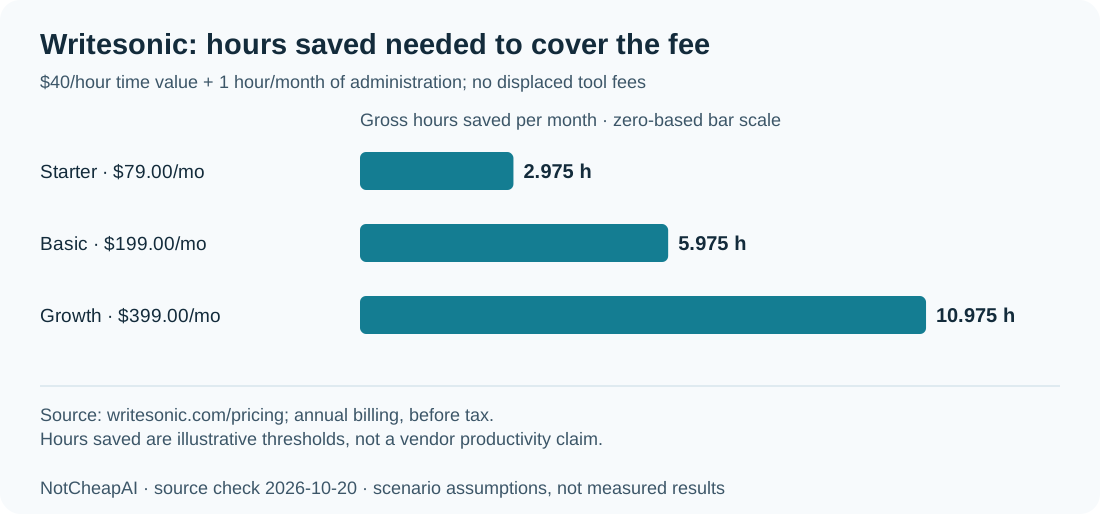
| Plan | Fee + admin value / month | Gross hours saved needed / month |
|---|---|---|
| Starter | $119.00 | 2.975 |
| Basic | $239.00 | 5.975 |
| Growth | $439.00 | 10.975 |
Scenario: 45 questions across three engines
Suppose your team wants one answer for each of 45 buying-intent questions on three engines every day. That is 135 observations daily, or 4,050 in a 30-day planning month. These are our monitoring requirements, not a promise about Writesonic’s sampling schedule.
If one engine response consumes one daily answer, Starter’s 50-answer allowance would support only 16 complete three-engine question sets; Basic’s 300 would cover the 135-response brief. Confirm that interpretation in a trial. If the product instead rotates coverage or defines answers differently, a simple division cannot establish the plan you need.
Compare vendors with this same brief: engines, region, language, refresh frequency, projects, export and users. Bundled writing is useful only when it displaces work or a subscription you actually need. A cheaper tracker with the required coverage can be better value than an unused bundle; a larger suite can win if its audits change what your team ships.
Run a bounded pilot before committing
Select a small set of buying-intent questions that buyers actually ask. Include your core category, specific use cases, and direct competitor comparisons. Repeating variations of your own brand name is less useful than seeing how prospects discover alternatives. The GEO getting-started documentation outlines topic and prompt management.
For two working weeks, log time spent reviewing answer changes, verifying citations, and editing site content. Separate software automation from human work: checking whether a citation gap actually matters and improving page schema remain manual responsibilities. Repeat occasional checks manually to confirm report accuracy.
At the end of the pilot, ask whether the report changed a product or content decision and whether recurring monitoring will be maintained. If not, even a Starter plan is an unnecessary recurring cost.
Choose the right comparison and stop double counting
Use our primary-source verification checklist when comparing GEO trackers. For the wider subscription budget, use the subscription stack audit and API versus Plus comparison.
Do not count unused bundled writing tokens as money saved if your marketing team would not have bought them separately. Start with a focused prompt set and a clear owner, upgrading only when measured monitoring limits prevent necessary work.
Always confirm billing terms, renewal rates, prompt capacity, seat limits, and cancellation policies at checkout. No affiliate commission or guaranteed ranking improvement is assumed.
Common questions
Do 50 tracked prompts guarantee daily results from three engines?
No. Prompt capacity and daily answer capacity are separate figures. Under a one-answer-per-engine interpretation, 50 daily answers cover 16 complete three-engine sets. Confirm actual sampling and allocation in the trial dashboard.
Is the $79 Starter price a monthly payment?
No. It is the monthly equivalent for annual billing ($948 upfront before tax). Month-to-month billing is $99 per month.
What is the simplest break-even test for staff time?
At an assumed $40/hour and one hour of monthly administration, Starter must save 2.975 gross hours per month on annual billing to cover its $79 fee and $40 administration value. Month-to-month billing requires 3.475 hours.
How should I compare GEO trackers?
Use the same questions, engines, locations and refresh schedule. Then compare the full fee, users, projects and work required to act on the reports. An AI mention alone does not show that the subscription earned its cost.
Sources and verified documentation
Official vendor plan and documentation links checked for this guide:
The site's separate workflow calculator uses the full calculation rules. Report a correction with the official source and affected scenario.