Unstructured vs LlamaParse vs Azure Document Intelligence: Real Document Parsing Cost per 1 Million Pages in 2026
The bottom line: Parsing one million pages costs $15,000 on Unstructured, $3,750 with LlamaParse Cost-effective, or $1,500 with Azure Read at published standard rates. If you're feeding enterprise PDFs, financial filings, or scanned invoices into an LLM or RAG pipeline, ingestion quietly becomes one of your bigger line items, so it pays to look closely.
The catch is that raw dollar figures only tell half the story. Pulling flat text from a clean digital PDF is a very different job from parsing multi-column layouts, nested tables, and handwritten receipts. Crank LlamaParse up to Agentic Plus and the cost jumps to $56,250 per million pages (at 45 credits/page), while a specialized 90-credit legacy preset doubles that to $112,500. Averaging those configurations into one tidy midpoint doesn't describe any tier you can actually buy, so we won't.
My practical rule of thumb: pick the cheapest parser that gets your hardest documents right, then route the easy ones to something cheaper. Paying premium rates on every page is the document-parsing version of leaving a forgotten subscription running.
Rates checked 28 October 2026, USD before tax. Azure calculations reflect Central US pay-as-you-go pricing. These estimates cover direct API processing charges only. They don't include vendor benchmark claims, setup labor, or an all-inclusive managed invoice.
What each vendor bills
Unstructured. According to the official pricing page, Serverless usage runs at a flat $0.015 per page, with a one-time 10,000-page signup grant. Custom VPC and enterprise deployments require a direct quote. Our recurring monthly benchmark assumes that initial allowance has already been used up. An account with its full 10,000-page onboarding credit still available pays $14,850 for its first million pages.
LlamaParse. The current rate card meters consumption at $1.25 per 1,000 credits. The v2 parsing tiers charge 1 credit/page for Fast, 3 credits for Cost-effective, 10 credits for Agentic, and 45 credits for Agentic Plus. The specialized v1 form/invoice pipelines consume 90 credits per page. That's a distinct extraction mode, not a conflicting price for v2 Agentic Plus. For standard text-only extraction, the 1-credit Fast tier works out to $1,250 per million pages. Advanced visual grounding and multimodal add-ons bill separately.
Azure Document Intelligence. The official regional price table for Central US lists Read at $1.50 per 1,000 pages for the first 1M, prebuilt models at $10 per 1,000, and custom extraction at $30 per 1,000. Volume above 1M pages drops to a lower published tier on Read, so avoid extrapolating the first-million rate forever. Azure also includes a 500-page monthly free allowance (F0 tier). What to keep in mind: treat that as an evaluation tier, not an automatic monthly deduction on enterprise S0 subscriptions.
Three page mixes
To compare realistic workloads, we map three typical production routing scenarios:
- A: digital PDFs. Clean born-digital documents using LlamaParse Cost-effective versus Azure Read and Unstructured's flat tier.
- B: scanned documents. Low-contrast scanned paper using LlamaParse Agentic versus an Azure prebuilt layout or document model.
- C: complex tables/forms. Financial spreadsheets and nested government forms using LlamaParse Agentic Plus versus Azure custom extraction.
Cost per 1 million pages by mix
The billing formulas are refreshingly simple: Unstructured = pages × $0.015; LlamaParse = pages × selected credits/page × $1.25 ÷ 1,000; Azure = pages × selected price per 1,000 ÷ 1,000. Storage, vector indexing, and developer engineering are tracked separately.
| Page mix / selected service | Unstructured | LlamaParse | Azure Document Intelligence |
|---|---|---|---|
| A: digital PDFs / Cost-effective / Read | $15,000 | $3,750 | $1,500 |
| B: scans / Agentic / prebuilt | $15,000 | $12,500 | $10,000 |
| C: complex / Agentic Plus / custom extraction | $15,000 | $56,250 | $30,000 |
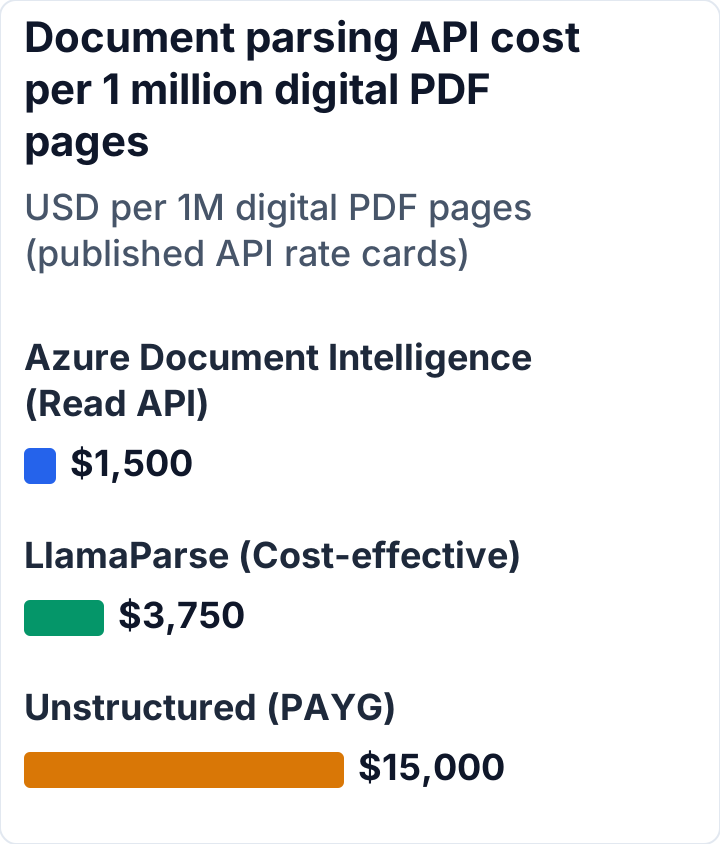
At a smaller scale of 10,000 pages, the raw usage values are $150 on Unstructured, $37.50 / $125 / $562.50 on LlamaParse, and $15 / $100 / $300 on Azure. At 100,000 pages, multiply those totals by ten. Account tier minimums can change what you actually pay at small volumes, which brings us to the next section.
Included credits and the minimum monthly bill
As outlined in the LlamaParse billing rules, accounts can choose Free (10,000 monthly credits), Starter ($50/month including 40,000 credits), or Pro ($500/month including 400,000 credits). The Free tier stops processing when credits run out. Paid tiers allow metered overage at $1.25 per 1,000 credits, up to your configured spend cap.
On a Starter tier, compute your monthly invoice as: $50 + max(0, required credits − 40,000) × $1.25 / 1,000. Processing 10,000 Cost-effective pages consumes 30,000 credits, so your invoice is the baseline $50, not the raw $37.50 usage value. Processing one million pages requires 3M credits, which gives $50 + 2.96M × $1.25 / 1,000 = $3,750. Don't add the subscription fee on top of gross usage a second time. It's an easy spreadsheet slip.
Configuration changes matter more than a midpoint
On LlamaParse, stepping up from Cost-effective (3 credits) to Agentic (10 credits) increases your bill by 233%. Jumping to Agentic Plus (45 credits) makes it 4.5 times as expensive as Agentic. Opting for a 90-credit legacy preset doubles your cost to $112,500 per million pages.
On Azure, prebuilt models run 6.67 times the cost of basic Read, while custom extraction runs 20 times higher. Unstructured keeps its flat $0.015 rate regardless of visual complexity.
In real-world production, a lower sticker price means little if the parser drops table borders or scrambles key-value pairs. Cleaning up bad extractions downstream usually costs more than the parsing fee you saved.
Retries, caching and billing units
Don't assume failed API requests are automatically forgiven, or that re-parsing the same document is free. A separately billed 3-credit exploratory pass followed by a 10-credit fallback pass consumes 13 total credits. On the plus side, LlamaParse offers a built-in 48-hour parsing cache. If your application submits the identical document with identical options within two days, you avoid redundant parsing charges.
Page boundaries also aren't universal across file formats. A 50-page PDF and fifty single-page files contain the same 50 pages, but create very different API connection overhead. When parsing Excel sheets, LlamaParse bills per sheet, and audio files are billed per minute. Check what each endpoint actually meters before translating file counts into page estimates.
Choose from a representative sample
Before signing an enterprise contract, work out whether your downstream LLM needs plain text, hierarchical markdown headings, structured HTML tables, or a strict Pydantic JSON schema. Then route a 1,000-page representative batch through your candidate endpoints and compare the output quality side by side. An afternoon of testing beats a year of guessing.
For a realistic pipeline with mixed complexity, such as 80% standard digital PDFs on Cost-effective and 20% complex financial statements on Agentic Plus, LlamaParse averages $14,250 per million pages (0.8 × $3,750 + 0.2 × $56,250) before plan discounts. Weight your actual page distribution linearly and you'll have a document parsing budget that holds up when finance asks questions.