Lokalise vs Phrase vs Smartling: Real AI Localization Cost per Language
Executive overview
Localization platforms have changed a lot lately. The old seat-heavy licenses are giving way to usage-based billing built around processed words and AI translation pipelines. If you're comparing tools using figures from a year or two ago, you're almost certainly looking at pricing models that no longer exist. It happens to all of us, usually right after we've already bookmarked the wrong pricing page.
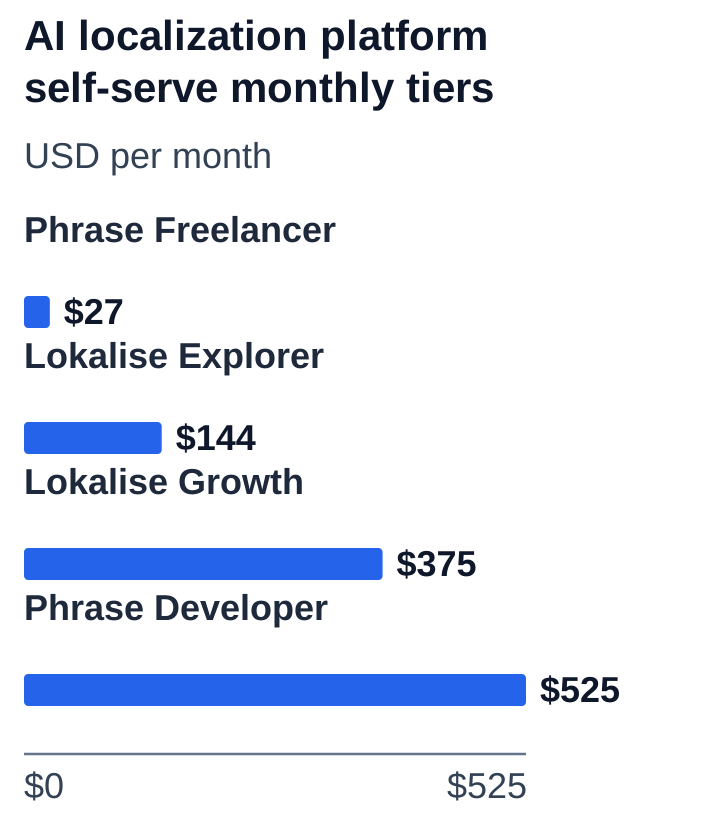
Lokalise has three clear self-serve plans ($144 to $999 monthly) with unlimited reviewer and translator seats. Your spend is metered mainly on monthly processed words. Phrase (formerly PhraseApp and Memsource) restructured its self-serve catalog into two distinct extremes: an entry-level $27 monthly single-seat Freelancer option and a $525 monthly Developer tier. Teams that fall in between get steered toward a sales conversation. Smartling runs a hybrid model. It publishes transparent starting rates for translation services ($0.0075 to $0.20 per word, depending on the mix of machine translation, AI post-editing, and professional human linguists), but keeps its core TMS platform subscription behind a custom enterprise quote. Real-world procurement benchmarks suggest Smartling enterprise contracts typically carry annual commitments two to three times higher than pure software platforms like Lokalise for equivalent baseline volume.
My practical rule of thumb: these three tools often aren't solving the same problem. Lokalise and Phrase are mostly software you operate, while Smartling is closer to a managed service with software attached. Once you see that, the price gaps make a lot more sense.
Pricing at a glance
| Lokalise | Phrase | Smartling | |
|---|---|---|---|
| Entry self-serve tier | Explorer — $144/month | Freelancer — $27/month (single seat) | Core (free-to-start) |
| Mid tier | Growth — $375/month | Developer — $525/month | Not published — sales conversation |
| High self-serve tier | Advanced — $999/month | Not self-serve — requires sales | Not published — sales conversation |
| Enterprise | Custom-quoted | Custom-quoted | Custom-quoted |
| Billing unit | Processed source words (not stored/hosted words), plus metered "advanced" seats for managers/developers | Processed words (as of the 2025–2026 restructure, moved away from seats/hosted keys) | Per-word translation-service rates, plus a separate, quote-based platform fee |
| Seats | Unlimited translator/reviewer seats on all paid plans; hosted words unlimited on all paid plans | Not itemized in currently available public pricing | Not itemized in currently available public pricing |
| Published translation-service rates | Not separately itemized — bundled into the processed-word plan price | Not separately itemized | Machine Translation from $0.0075/word; AI Translation from $0.06/word; AI Human Translation from $0.12/word; Human Translation from $0.20/word |
What headline pricing excludes
Both Lokalise and Phrase moved their core billing metric from hosted keys to processed words. Under the older TMS models, you paid for the total number of translation keys sitting in the database. Now your monthly invoice depends on how many source words flow through the translation workflow. The practical catch for engineering teams: if you run continuous integration pipelines with automated string extraction, frequent text revisions or multi-variant copy tests re-process words and eat through your monthly quota much faster than static database storage ever did.
Phrase left a noticeable gap in its self-serve tiers. The earlier tier lineup has been consolidated into the $27 Freelancer tier and the $525 Developer plan. Growing engineering teams that need collaboration without enterprise-level overhead often get pushed into a sales cycle sooner than they'd planned.
Smartling separates software access from language services. Its public per-word price sheet ($0.0075/word for raw MT up to $0.20/word for verified human translation) covers the linguistic work. The underlying TMS platform subscription is billed separately under an annual contract. To get your real total, you need to add both pieces together.
Operational caveats and hidden costs
- API rate limits on automated CI/CD pipelines: Lokalise enforces a 6 request-per-second limit across self-serve plans. If your team pushes localized strings across dozens of microservices or automated pull requests, batch your API calls so deployments don't get throttled.
- Role distinctions between basic and advanced seats: On Lokalise, linguists, reviewers, and external translators get unlimited seats across paid plans. Project managers, developers, and administrators who configure integrations and translation keys need "advanced" seats. Those are capped per tier and require paid add-ons as your internal engineering team grows.
- Overage pricing and volume boundaries: Base tier subscription fees are clearly published, but custom overage rates apply once you exceed your monthly processed-word quota. If you're planning seasonal product releases or rapid geographic expansion, model your expected translation bursts ahead of time. Future you will be grateful.
Worked scenarios
To show how these models turn into real monthly budgets, here are three common internationalization scenarios at different scales of product maturity and translation velocity.
Startup localizing into 3 languages
Assumption: roughly 50,000 words of source content per language, translated primarily via AI/machine translation with light human review — 150,000 total processed words/month across all three languages.
| Estimated monthly cost | |
|---|---|
| Lokalise Explorer | $144/month flat (assuming this volume fits within Explorer's unstated word allowance) |
| Phrase Freelancer | $27/month (single-seat; likely insufficient once more than one person needs access) |
| Smartling (translation services only, AI Translation tier) | 150,000 × $0.06 = $9,000 — plus an unpublished platform fee on top |
At early-stage startup scale, Lokalise Explorer and Phrase's self-serve plans give you predictable software subscriptions. Smartling's managed linguistic model, at $0.06 per word for AI translation, comes to $9,000 monthly before you add the software platform fee. That makes it structurally aimed at organizations that want managed vendor workflows rather than lightweight developer tooling.
SaaS product localizing into 10 languages
Assumption: roughly 100,000 words of source content per language, translated via a mix of AI and human review — 1,000,000 total processed words/month.
| Estimated monthly cost | |
|---|---|
| Lokalise Growth | $375/month flat (assuming this volume fits within Growth's unstated word allowance; may require Advanced if not) |
| Phrase | Likely requires a sales conversation at this scale — no confirmed self-serve tier covers this cleanly |
| Smartling (AI Human Translation tier, a more realistic quality bar for customer-facing SaaS content) | 1,000,000 × $0.12 = $120,000 — plus an unpublished platform fee |
At growth scale, a product team managing 10 active locales with one million monthly processed words gets a lot out of Lokalise's Growth or Advanced tier ($375 to $999/month). It bundles the workflow tooling and lets engineers connect their own LLM or MT engines. Routing that same volume through Smartling's managed AI-human hybrid tier ($0.12/word) comes to $120,000 monthly. That reflects full-service language vendor management rather than self-directed software tooling.
Enterprise localizing into 25 languages
Assumption: roughly 200,000 words of source content per language — 5,000,000 total processed words/month.
| Estimated monthly cost | |
|---|---|
| Lokalise | Almost certainly requires Enterprise (custom-quoted) at this scale — Advanced's $999/month price point is a self-serve ceiling, not necessarily sufficient volume |
| Phrase | Enterprise, custom-quoted |
| Smartling (Human Translation tier, appropriate for many enterprise/regulated content types) | 5,000,000 × $0.20 = $1,000,000 — plus an unpublished platform fee |
At enterprise scale, all three providers work under custom enterprise MSAs with dedicated service level agreements, custom security compliance, and bespoke word allocations. In regulated industries where legal, compliance, or medical terminology calls for certified human linguists, Smartling's $0.20 per word rate shows where the money goes: linguistic spend is the vast majority of total localization expenditure, and the TMS software subscription is a secondary component.
Normalizing across billing units
When you're putting these platforms side by side, you'll end up juggling two different yardsticks:
- Cost per language locale: For Lokalise and Phrase, language count is largely decoupled from pricing. Adding a tenth or eleventh locale costs very little extra if your overall word volume stays steady within your tier quota.
- Cost per 100,000 processed words: This metric directly reflects linguistic consumption. On Lokalise and Phrase, unit costs scale predictably with software tiers. On Smartling, 100,000 words translates to $750 in pure machine translation, $6,000 in AI post-editing, or $20,000 in professional human translation, which gives content operations clear unit predictability.
In real-world production, per-word math is the more honest comparison whenever a human vendor is in the loop. Per-language math only really works for the software-first tools.
Strategic decision framework
The best platform depends on whether your team needs developer infrastructure or full-service translation outsourcing:
- Engineering-led product teams: If your developers want automated GitHub Actions integration, Figma sync, comprehensive REST APIs, and the freedom to bring their own AI translation models, Lokalise offers the most flexible self-serve path with transparent tier pricing.
- Mid-market enterprises with established vendor relationships: Phrase provides robust enterprise TMS capabilities, particularly for teams with complex legacy translation memory databases, provided you negotiate a structured multi-seat enterprise contract.
- Global brands requiring end-to-end quality guarantees: If you don't have an internal localization department and need an enterprise partner to manage linguist vetting, compliance audits, and multi-language delivery SLAs, Smartling's managed services model justifies its higher platform commitment.
If you're still on the fence, my verdict is simple. If your developers own localization day to day, start with the self-serve software and keep your budget for the day you really need it. If localization is a managed business function with compliance stakes, the higher Smartling commitment is buying you something real, so it's worth the conversation.