Creatify Boreal AI Video Cost: Is $0.01 Per Second Actually Cheap?
Direct answer
Yes, $0.01 per second at 720p is a legitimate price on fal.ai, and it makes Boreal one of the most accessible generative video models out there right now. The catch is that you shouldn't build a marketing or creative budget around raw per-second rates alone. The number that actually shows up on your P&L is cost per usable clip.
Creatify built Boreal by fine-tuning Lightricks' open-weights LTX-2.5 model (22B parameters) on high-performing direct-response advertising creative. On Creatify's published 20-prompt advertising benchmark, Boreal hit a 70% pass rate when scored against human-produced reference videos. In plain terms, roughly three out of ten generations needed revisions or didn't meet commercial publishing standards. Even with realistic retries, Boreal stays remarkably cheap, but it's worth understanding how those retries shape your bill before you wire it into a high-volume ad testing pipeline.
On fal.ai, where the developer billing actually happens, the pricing is refreshingly straightforward: $0.01 per second at 720p, $0.03 per second at 1080p, and $0.12 per second at 2K resolution. A 10-second clip costs $0.10 in 720p, $0.30 in 1080p, and $1.20 in 2K. Synchronized native audio (dialogue, ambient Foley, and background music) is generated jointly with the video track at no extra charge.
What's confirmed directly from Creatify and fal.ai
I checked the live documentation on Creatify Labs and fal.ai/models/creatify/boreal, and here's what holds up:
- Model architecture and release: Launched September 15, 2026, Boreal adapts the 22B-parameter LTX-2.5 open video architecture for e-commerce and performance marketing, with joint audio-visual synthesis.
- Clear developer API pricing on fal.ai: $0.01/sec (720p), $0.03/sec (1080p), and $0.12/sec (2K). For example, a 10-second social video costs $0.10, $0.30, or $1.20 across the three respective tiers.
- Output specifications: Clips render up to approximately 20 seconds at 24 frames per second in landscape (16:9), vertical portrait (9:16), square (1:1), and traditional 4:3 or 3:4 formats, delivered as standard H.264 MP4 files with AAC audio.
- Native audio included: No need for a separate audio generator. Boreal produces synchronized voice, sound effects, and ambient background audio in the same pass.
- Rendering speed: Generation takes roughly one second of compute per second of finished video, which is a nice turnaround advantage over heavily queued commercial models.
- Comparative positioning: In Creatify's own comparison benchmarks, a 5-second 720p clip runs around $0.05 on Boreal, compared to approximately $0.50 on Veo 3.1 Fast, $0.56 on Kling 3.0 Pro, and $0.60 on Seedance 720p.
- Platform access pathways: You can run Boreal through raw API requests on fal.ai, or through Creatify's web platform, which offers Starter at $39/month and Pro at $99/month on a rolling credit system. If you're leaning toward the web studio, check how many credits each video deducts from your account before you estimate costs.
Cost per usable clip: the core calculation
Cost per usable clip = total generation spend ÷ number of usable clips. At $0.01/sec (720p), a 5-second attempt costs $0.05. If every attempt were usable, your cost per usable clip would be exactly $0.05. Of course, not every attempt is a keeper, so here's what different success rates do to the number:
| Attempts needed per usable clip | Cost per usable clip (5-sec, 720p) |
|---|---|
| 1 (best case) | $0.05 |
| 1.43 (Creatify's own 70%-pass-rate benchmark, as a reference point — see caveat above) | $0.0715 |
| 2 | $0.10 |
| 5 | $0.25 |
| 10 (worst case modeled here) | $0.50 |
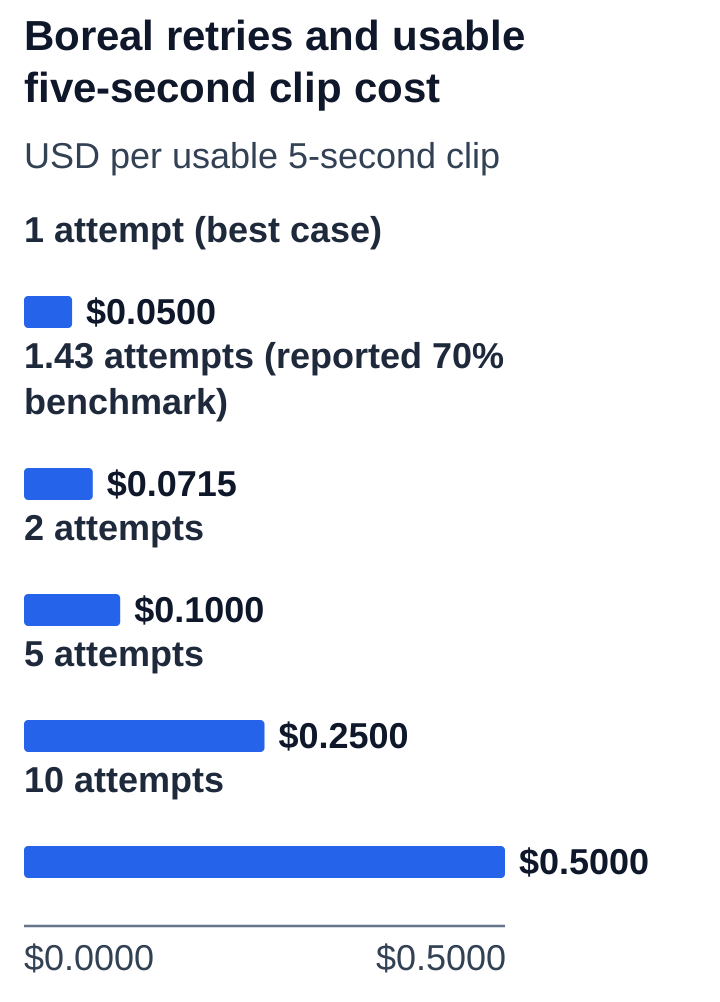
The 1.43-attempts baseline comes from the 70% success benchmark (1 ÷ 0.70 ≈ 1.43). In real production, your own success rate will move around depending on prompt complexity, product category, and brand guidelines. Simple talking-head or product-spin concepts may pass on the first try, while intricate multi-subject lifestyle shots might take four or five takes.
The big takeaway: even in a rough 10-attempt scenario ($0.50 per usable clip), Boreal costs about the same as a single attempt on competing closed platforms like Veo or Kling. That price cushion means your team can iterate aggressively without sweating the experimental budget.
Batches of ad variants: the scenario that actually matters
Performance marketers almost never need just one creative asset. The usual playbook is testing 10 to 20 hook variations, visual angles, and calls to action across TikTok, Meta, and YouTube Shorts. For a campaign batch of 10 finished, client-ready 5-second clips:
| Attempts/clip assumption | Total generations needed | Raw generation cost (10 clips) |
|---|---|---|
| 1 | 10 | $0.50 |
| 1.43 (benchmark reference) | ~14.3 | $0.715 |
| 2 | 20 | $1.00 |
| 5 | 50 | $2.50 |
| 10 | 100 | $5.00 |
Across that whole range, 10 approved video variants cost between $0.50 and $5.00 in raw API compute. At those prices, compute stops being the thing that constrains your agency or marketing team.
Practical economics: producing ad variant batches for clients
So where does the money actually go? Picture an agency delivering 10-clip creative variant packages to e-commerce clients. Say an editor or creative strategist spends 15 minutes reviewing, selecting, color-checking, and lightly trimming each usable clip. At an illustrative internal labor rate of $30/hour ($7.50 per clip), and using the conservative 10-attempts-per-clip compute assumption:
| Cost component | Calculation | Cost |
|---|---|---|
| Generation (worst case, 10 attempts/clip) | 100 generations × $0.05 | $5.00 |
| Human review/editing (10 clips × 15 min) | 10 × $7.50 | $75.00 |
| Total cost per batch | $80.00 |
If the agency bills the client $500 for the tested 10-variant creative pack, gross profit is $420, an 84% gross margin.
Here's the part worth underlining: human review and editing makes up 94% of production cost ($75.00 out of $80.00), while AI compute accounts for just 6% ($5.00). Hunting for a cheaper video model won't meaningfully widen your margin. The real gains come from tighter prompting templates, standardized review criteria, and automated asset ingestion that cuts down editor triage time.
Key factors that shape your final invoice
- Resolution trade-offs: 1080p ($0.03/sec) is 3x more expensive than 720p ($0.01/sec), and 2K ($0.12/sec) is 12x higher. For mobile social placements on TikTok and Instagram Reels, 720p or 1080p is almost always plenty, since the platforms compress everything aggressively anyway.
- Platform versus API billing: fal.ai charges strictly for raw compute consumed. Creatify's web studio bundles templates, UGC scripting, and digital avatars into monthly subscriptions with credits. Double-check which billing model your team is actually using, because the two behave very differently.
- Prompt refinement versus blind regeneration: Re-running the same vague prompt and hoping for a better result burns credits and editor time (the classic "just one more roll" trap). When a generation fails, look at whether negative prompts, camera motion tags, or seed changes can fix the flaw systematically.
Practical recommendations
- Model budgets around approved clips, not raw renders: Base your project quotes on your measured pass rate rather than theoretical vendor minimums.
- Track your team's real pass rate over the first 50 generations: A simple spreadsheet logging the attempts needed per keeper is enough. You can plug that empirical multiplier straight into your financial planning.
- Streamline the review workflow: Since human review makes up over 90% of your production costs, write clear acceptance rubrics so junior creators or assistants can filter out flawed takes before senior editors have to look at them.
- Verify live API rates on fal.ai before signing long-term client contracts: Keep your working rate cards in sync with the live platform documentation.
FAQ
Is Boreal really $0.01 per second? Yes. On fal.ai's live API model page, 720p rendering is billed at $0.01 per second, with 1080p at $0.03 and 2K at $0.12.
Does a 70% benchmark pass rate mean 30% of my videos will fail? Not necessarily. Creatify's 70% figure comes from their standardized 20-prompt advertising benchmark, evaluated against human creative references. Your real-world pass rate will depend on your prompts, product assets, and your brand's tolerance for minor artifacts.
Is Boreal cheaper than Veo, Kling, or Seedance even after retries? Yes. Even if you discard 9 out of 10 generations (a 10x retry rate), a 5-second 720p clip costs roughly $0.50, which is still equal to or below a single first-pass attempt on premium enterprise closed models.
Should I access Boreal through Creatify or through fal.ai directly? If your team has developer resources or uses n8n/Make to automate ad pipelines, fal.ai gives you direct, metered per-second billing. If you'd rather have a complete browser-based creative suite with pre-built UGC templates, avatar lip-syncing, and timeline editing, Creatify's web application is the managed option.