Momentic vs mabl vs Testim: Real AI Software Testing Cost per 10,000 Test Runs in 2026
The short answer: Momentic is the only one of these three with a fully public, self-serve price list; mabl and Testim (now owned by Tricentis) are both entirely quote-gated, and Testim's public pricing page as of mid-2026 lists no dollar figures at all for any paid tier. On Momentic's published credit meter, 10,000 test runs a month (at an average of 10 steps per run) costs about $1,813, and 100,000 runs about $18,688.
Industry procurement data places mabl plans between $499 and $3,000+ per month, while Tricentis Testim enterprise contracts typically range from $10,000 to $50,000 a year depending on team size and parallel execution needs. Because mabl and Testim do not publish open execution meters, evaluating real return on investment requires understanding where each vendor draws the line between local CI execution and billable cloud infrastructure.
Because mabl and Testim don't publish open execution meters, working out your real return on investment comes down to understanding where each vendor draws the line between local CI execution and billable cloud infrastructure. My practical rule of thumb: don't compare sticker prices, compare how many of your runs actually land on the vendor's meter. That number tends to surprise people.
Pricing models and billing mechanics
Momentic: Step-based credit metering
Momentic uses a consumption model with zero per-seat licensing fees. Billing is calculated on test steps rather than high-level test cases: one credit equals one executed test step, including AI-driven actions, locator auto-healing, and failure-recovery maneuvers. A typical end-to-end UI journey averages around 10 steps, so one test run burns roughly 10 credits.
- Free tier: $0 forever. Includes 2,000 credits per month (about 200 standard test runs) with a hard cap at the limit and unlimited team seats.
- Pay-as-you-go: $125 per month. Includes 10,000 credits (about 1,000 test runs) with no hard stops. Overage is billed at $0.01875 per credit. Includes 2 Android and 1 iOS cloud device slots and 5 virtual phone numbers for automated SMS/OTP verification workflows.
- Enterprise tier: Custom contract pricing based on annual test volume. Adds SAML SSO, SCIM provisioning, compliance audit logs, extended mobile session limits, and a dedicated technical account manager.
- Local authoring: Interactive runs and debugging inside the local test editor are completely free and don't draw from your monthly credit allowance.
mabl: Cloud execution versus unmetered CI
mabl gates its commercial tiers behind sales consultations. Historically, industry procurement benchmarks place entry-level Starter packages around $499 per month (providing roughly 500 cloud-run credits), Growth/Professional tiers between $1,200 and $3,000 per month, and full Enterprise deployments starting at $40,000+ per year.
Where mabl really shines is how it splits workloads: local developer executions and headless runs inside your own CI/CD pipeline (e.g., GitHub Actions or GitLab CI) are completely free and unmetered. Only cloud runs, meaning tests dispatched to execute across mabl's managed multi-browser cloud infrastructure, consume monthly credits.
What to keep in mind: a software engineering organization that executes 90% of its smoke tests in self-hosted CI pipelines and reserves mabl's cloud grid for cross-browser visual regression testing will see vastly lower effective costs than a team running every pull-request run in the cloud.
Tricentis Testim: Enterprise suite packaging
Since Tricentis acquired Testim in 2022, the platform has been packaged as an enterprise testing suite spanning Web, Mobile, and Salesforce applications. Public dollar figures aren't listed on the website, so every paid implementation requires a tailored sales quote.
The Community tier remains freely accessible, providing basic automated test authoring and 1,000 monthly runs on Chrome, which makes it a handy sandbox for exploratory automation. Commercial contracts typically follow annual, seat-based agreements. Procurement data suggests smaller QA teams (3 to 5 engineers) see proposals starting near $10,000 per year, while mid-market engineering teams (10+ SDETs) frequently see quotes spanning $20,000 to $50,000 annually, bundling minimum seat counts and dedicated support.
Momentic cost by volume
Formula: credits = test runs × 10 (steps per run, ILLUSTRATIVE average); cost = $125 + max(0, credits − 10,000) × $0.01875 above the Pay-as-you-go base, or $0 up to 200 runs on Free.
| Test runs/month | Credits consumed | Momentic cost | Cost per 10,000 runs |
|---|---|---|---|
| 1,000 | 10,000 | $125.00 | $1,250.00 |
| 10,000 | 100,000 | $1,812.50 | $1,812.50 |
| 100,000 | 1,000,000 | $18,687.50 | $1,868.75 |
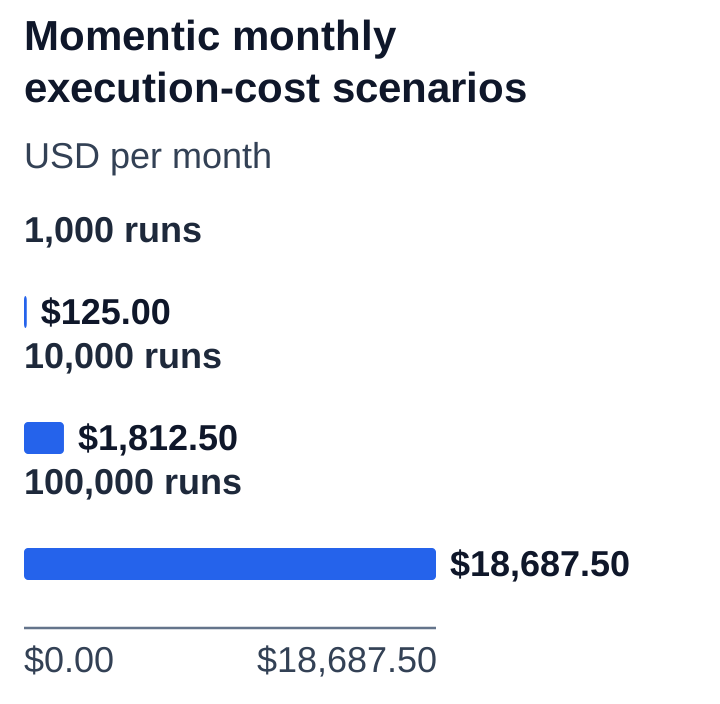
Momentic's base tier includes 10,000 credits for $125 (an effective rate of $0.0125 per credit), and overage after that is fixed at $0.01875 per credit. So the blended cost per 10,000 test runs creeps up slightly from $1,250 to approximately $1,869 at higher volumes. Nothing scary, but worth knowing when you forecast.
mabl and Testim: what can and cannot be compared
Neither mabl nor Testim publishes open per-run rate cards, so a direct side-by-side pricing table would give you misleading precision. Nobody needs a spreadsheet that looks exact and isn't.
On mabl, a $499/month starter tier provides 500 cloud-run credits. Because a team's self-hosted CI runs are unmetered, the effective cost per 10,000 total test runs depends entirely on your cloud-versus-local execution split. A team running 9,500 tests in GitHub Actions and only 500 in mabl's cloud pays $499 total, whereas a team routing all 10,000 runs through mabl's cloud infrastructure would need a top-tier enterprise agreement.
Tricentis Testim contracts, meanwhile, are priced primarily on engineer seats, enterprise platform connectors, and annual commitments rather than a flat per-test counter. A $30,000 annual contract covers unlimited local executions for an entire engineering organization, but turning that into a per-10,000-run metric requires knowing your team's specific test velocity.
Concurrency and parallel execution
Fast feedback loops in CI/CD depend on running tests in parallel, so it's worth checking what each vendor actually includes:
- Momentic: The Pay-as-you-go plan includes parallel cloud execution without separate concurrency line items, though mobile physical device testing is capped at 2 Android and 1 iOS simultaneous connections.
- mabl & Testim: Parallel execution capacity is typically tied to contracted cloud runners or seat licenses. When negotiating enterprise quotes with either vendor, explicitly verify how many parallel browser threads are included during peak PR merge windows.
Break-even: human test-maintenance hours saved
Formula: hours needed = monthly cost ÷ loaded hourly rate, with $85 an hour for a QA/SDET engineer (ILLUSTRATIVE). This is a threshold: the tool pays for itself if it saves this many hours of manual test-maintenance and flake-fixing work, not a claim that it will.
| Case | Monthly cost | Hours to break even |
|---|---|---|
| Momentic, 1,000 runs/month | $125 | 1.5 |
| Momentic, 10,000 runs/month | $1,813 | 21.3 |
| Momentic, 100,000 runs/month | $18,688 | 219.9 |
| mabl Starter (REPORTED estimate) | $499 | 5.9 |
| mabl Growth/Professional (REPORTED estimate, midpoint) | $2,100 | 24.7 |
| Testim/Tricentis, small team (REPORTED estimate, midpoint) | $833 | 9.8 |
| Testim/Tricentis, mid-market (REPORTED estimate, midpoint) | $2,917 | 34.3 |
At moderate volumes (1,000 to 10,000 test runs per month), AI-driven test maintenance and self-healing locators only need to save between 2 and 25 engineering hours per month to justify the subscription. That's a pretty reachable bar if your team spends real time babysitting flaky tests.
At 100,000 monthly runs on Momentic ($18,688/mo), the break-even requirement rises to 220 engineering hours, the equivalent of an entire full-time SDET. At that scale, it's worth auditing whether self-healing locators are actually eliminating flake or just masking deeper backend regressions. In real-world production, a test that quietly "heals" around a genuine bug isn't saving you anything.
Key variables that determine your bill
- Step depth per test: Momentic charges per step. A suite of 50-step end-to-end checkout flows will consume credits 5x faster than a suite of lightweight 10-step smoke tests.
- Cloud vs CI split on mabl: Maximize local CI/CD runners to keep mabl expenses confined to your base subscription tier.
- Seat count versus usage on Testim: Because Tricentis contracts often price per seat, adding manual QA testers, developers, and product managers can expand renewal costs faster than test suite growth.
Practical budgeting advice
- Pilot with your flaky tests first: Before signing an enterprise contract, import your 10 most brittle, flake-prone UI tests. Measure whether AI self-healing truly stabilizes them across 100 consecutive CI runs.
- Demand burst concurrency in quotes: When talking to mabl or Tricentis sales reps, make sure parallel execution limits match your maximum pull-request merge volume, so your CI pipeline doesn't become a bottleneck.
- Audit credit burn weekly on Momentic: Overage is metered at $0.01875 per step without automatic volume discounts, so set up billing alerts to catch run-away infinite loops in scheduled CI suites. Future you will be grateful when that one forgotten nightly job doesn't eat the budget.